
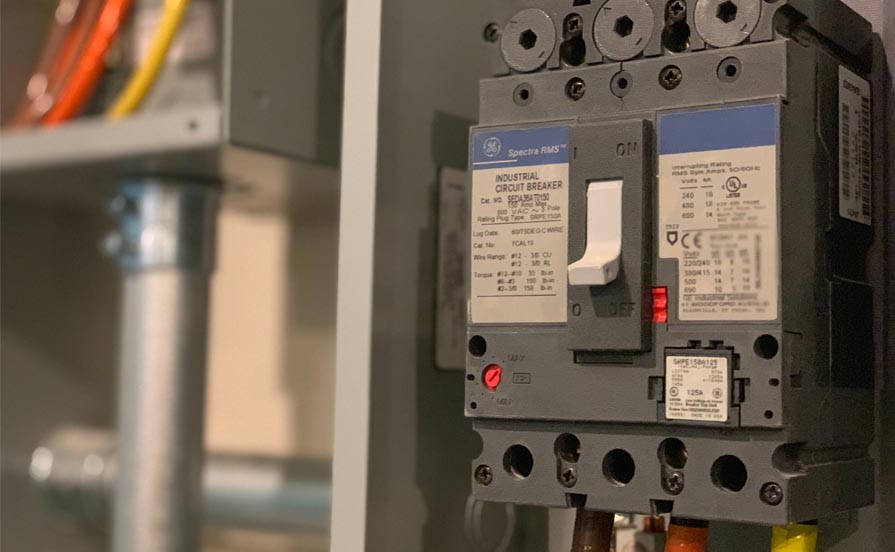
MCB

MCB stands for Miniature Circuit Breakers.
The MCB is an electromechanical device that switches off the circuit automatically if an abnormality is detected. The MCB easily senses the overcurrent caused by the short circuit. The miniature circuit has a very straightforward working principle.
The trip curve of an MCB’s (B, C, D, K and Z curves) tell us about the trip current rating of Miniature Circuit breakers. The trip current rating is the minimum current at which the MCB will trip instantaneously. It is required that the trip current must persist for 0.1s.
The MCB trip curves, also known as I-t tripping characteristic consist of two sections viz, overload section and short circuit section. The overload section describes the trip time required for various levels of overload currents and the short circuit section describes the instantaneous trip current level of MCB.
Class B trip curve
The MCB with class B trip characteristics trips instantaneously when the current flowing through it reaches between 3 to 5 times the rated current. These MCBs are suitable for cable protection. This type of circuit breaker is used for purely resistive loads or loads with a very small inductive component. (Domestic Load) like Lighting circuits (non-inductive) and General purpose outlets
Class C trip curve
MCB with class C trip characteristics trips instantaneously when the current flowing through it reaches between 5 to 10 times the rated current. Suitable Domestic and residential applications and electromagnetic starting loads with medium starting currents. Type C MCB is used for motor circuits (circular saws and smaller pumps), air conditioners and larger lamp groups (e.g. fluorescent lighting).
Class D trip curve
MCB with class D trip characteristics trips instantaneously when the current flowing through it reaches between Above 10(excluding 10) to 20 times the rated current. Suitable for inductive and motor loads with high starting currents. D-rated MCBs are built for heavy-duty commercial and industrial devices where very strong current surges occasionally occur. Examples include welding equipment, X-ray machines, large motors, and uninterruptible power supply units.
Common available MCB Ampere Rating in the market is: 1A-2A-4A-6A-10A-13A-16A-20A-25A-32A-40A-50A-63A-80A-100A-125A
DC Circuit Breaker
A DC circuit breaker is operating with DC and contains additional arc-extinguishing measures.
RCD

An “RCCB” or “RCD” (or RCB!), or residual current device or ”GFCI” (ground fault circuit interrupter). , is a life-saving device that is designed to prevent you from getting a fatal electric shock if you touch something live, such as a bare wire. RCDs offer a level of personal protection that ordinary fuses and circuit-breakers cannot provide. RCD is an electrical wiring device that disconnects the circuit as soon as it detects a current leak to the earth wire.
There are three types of RCD that are commonly used. They are called the RCD output, the portable RCD and the RCD circuit breaker.
RCBO

RCBO (Residual Current Breaker with Over-Current.) This protection is achieved by monitoring the current flow in the line and neutral. In a healthy circuit, the current flow via the line equals the return flow in the neutral.RCBO stands for Residual Current Breaker with Over-Current. The RCBO combines the functionality of an MCB (So it has MCB curve) and RCD/RCCB. When there is a current leakage, the RCBO trips the entire circuit. Consequently, internal magnetic/thermal circuit breaker components can trip the electronic device when the circuit is overloaded.
MCCB

A moulded case circuit breaker (MCCB) is a type of electrical protection device that is used to protect the electrical circuit from excessive current, which can cause overload or a short circuit. The biggest difference between MCB and MCCB is Rated Current. In MCCB rated current is up to 1600A as long as it is up to 125 A in MCB
Air Circuit Breaker

An air Circuit Breaker (ACB) is an electrical device used to provide Overcurrent and short-circuit protection for electric circuits over 800 Amps to 10K Amps (Bigger than MCCB). An Air Circuit Breaker is a circuit operation breaker that operates in the air as an arc extinguishing medium, at a given atmospheric pressure.
Fuses
These categories indicate the intended application of the fuse:
- gG (General Purpose): These are full-range breaking capacity fuses used for the protection of cables, lines, and general-purpose circuits. They provide both overload and short-circuit protection. The former designation for this category was gL.
- aM (Motor Protection): These are partial-range breaking capacity fuses designed specifically for the short-circuit protection of motor circuits. They have a time-delay characteristic to withstand the high inrush currents during motor startup. Overload protection for the motor is typically provided by a separate thermal overload relay.
- gR / aR (Semiconductor Protection): These are very fast-acting fuses designed to protect sensitive semiconductor devices like diodes, thyristors, and transistors from short circuits.
gRfuses offer full-range protection (overload and short-circuit), whileaRfuses provide partial-range (short-circuit) protection. - gS: These fuses are for the protection of semiconductor devices and also offer general-purpose (gG) characteristics.
- gPV (Photovoltaic Protection): These are specifically designed for the protection of photovoltaic (solar) strings and arrays.
here is a simple list of common fuse types:
- HRC (High Rupturing Capacity) Fuse: A high-performance fuse, typically ceramic-bodied and sand-filled, capable of safely interrupting very high short-circuit currents.
DIN-type HRC fuses, commonly known as NH (Niederspannungs-Hochleistungs) - Semiconductor Fuse: A very fast-acting fuse designed to protect sensitive electronic components like diodes, thyristors, and transistors from overcurrents.
- Rewireable (Kit-Kat) Fuse: An older style of fuse with a simple fuse wire that can be replaced when it blows. It offers lower breaking capacity and less reliable protection.
- Cartridge Fuse: A common type of fuse with the fuse element enclosed in a cylindrical glass or ceramic tube, often with metal end caps. They are used in appliances, plugs, and industrial equipment.
- Automotive (Blade) Fuse: Plastic-bodied fuses with two metal prongs designed for use in vehicle electrical systems.
- Resettable Fuse (PTC): A solid-state device that acts like a self-resetting fuse. When it overheats due to overcurrent, its resistance increases dramatically, limiting the current. It resets when it cools down.
- Thermal Fuse: A single-use fuse that opens a circuit when a specific temperature is exceeded, commonly found in heat-producing appliances like coffee makers and hair dryers.

 Electrical Engineer