
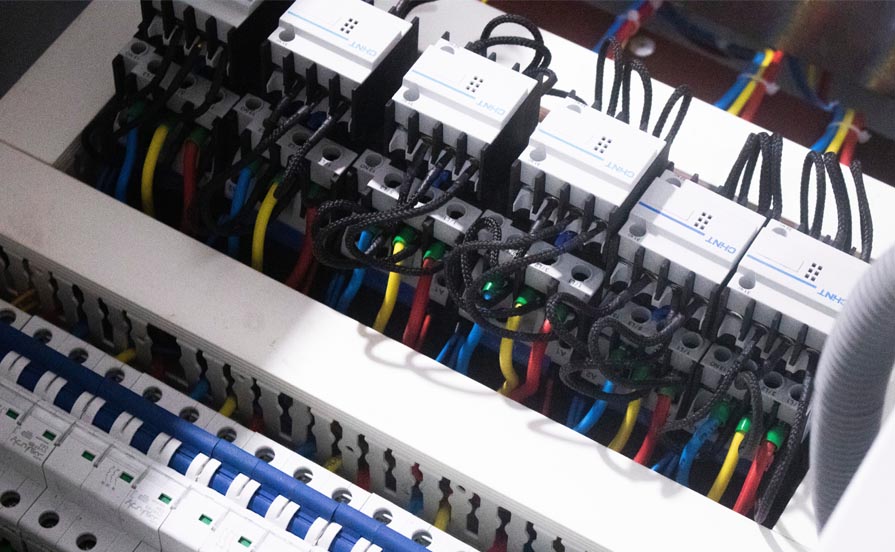
A contactor is an electrical device that is used for switching an electrical circuit on or off. … These contacts are in most cases normally open and provide operating power to the load when the contactor coil is energized. Contactors are most commonly used for controlling electric motors. There are different types of contacts in a contractor. Auxiliary contact, Power contacts. The power contact has two types stationary and movable contact.
Standard Contactor
There are two different types of coil in the contactors (AC or DC ) also there are AC Contactor And DC Contactor which refers to contact

Safety Contactor
Safety contactor has auxiliary contacts permanently connected to the contactors. This feature avoids the possibility of the auxiliary contacts becoming separated from the contactor due to environmental causes such as shock and vibration. The normal contactor has both snap-on and snap-off auxiliary contacts.

Miniature Contactors
The mini contactor is a type of power contactor that is similar to the standard contactors in terms of operation but is smaller in size. It is suitable for applications where space saving is important. A mini contactor is used for switching motors up to 5.5 kW. Or they may use for lighting

Capacitor-Switching Contactors
Capacitor switching application leads to a very high current peak at capacitor energization
Capacitor switching contactors are fitted with early make contacts and damping resistors.

Auxiliary contact
Auxiliary contact is the contact in the auxiliary circuit that is operated mechanically. It is physically linked to the main contacts and activated at the same time. It does not carry so much current. Auxiliary contact is also referred to as supplementary contact or control contact.

NEMA Size
.tg {border-collapse:collapse;border-spacing:0;} .tg td{border-color:black;border-style:solid;border-width:1px;font-family:Arial, sans-serif;font-size:14px; overflow:hidden;padding:10px 5px;word-break:normal;} .tg th{border-color:black;border-style:solid;border-width:1px;font-family:Arial, sans-serif;font-size:14px; font-weight:normal;overflow:hidden;padding:10px 5px;word-break:normal;} .tg .tg-baqh{text-align:center;vertical-align:top} .tg .tg-8xib{background-color:#fffc9e;text-align:center;vertical-align:top}| NEMA SIZE | CONTINUS Amp Rating | HP 230v ac | HP 460v ac |
|---|---|---|---|
| 00 | 9 | 1 | 2 |
| 0 | 18 | 3 | 5 |
| 1 | 27 | 5 | 10 |
| 2 | 45 | 15 | 25 |
| 3 | 90 | 30 | 50 |
| 4 | 135 | 50 | 100 |
| 5 | 270 | 100 | 200 |
| 6 | 540 | 200 | 400 |
| 7 | 810 | 300 | 600 |
| 8 | 1215 | 450 | 900 |
| 9 | 2250 | 800 | 1600 |
IEC AC/DC duty for Contactors:
.tg {border-collapse:collapse;border-spacing:0;} .tg td{border-color:black;border-style:solid;border-width:1px;font-family:Arial, sans-serif;font-size:14px; overflow:hidden;padding:10px 10px;word-break:normal;} .tg th{border-color:black;border-style:solid;border-width:1px;font-family:Arial, sans-serif;font-size:14px; font-weight:normal;overflow:hidden;padding:10px 5px;word-break:normal;} .tg .tg-0lax{text-align:left;vertical-align:top}| AC-1 | “Non-inductive˙or slightly inductive loads, example:˙resistive˙furnaces, heaters” |
|---|---|
| AC-2 | Slip-ring motors: switching off |
| AC-3 | “Squirrel-cage motors: starting, switches off motors during running time” |
| AC-4 | “Squirrel-cage motors: starting, plugging, inching” |
| AC-5a | Switching of˙discharge lamps |
| AC-5b | Switching of˙incandescent lamps |
| AC-6a | Switching of˙transfomers |
| AC-6b | Switching of˙capacitor˙banks |
| AC-7a | “Slightly inductive loads in household appliances: examples: mixers, blenders” |
| AC-7b | “Motor-loads for household appliances: examples: fans, central vacuum” |
| AC-8a | Hermetic refrigerant compressor motor control with manual resetting overloads |
| AC-8b | Hermetic refrigerant compressor motor control with automatic resetting overloads |
| AC-12 | ontrol of resisitive loads and solid state loads with˙opto-coupler isolation |
| AC-13 | ontrol of solid state loads with transformer isolation |
| AC-14 | ontrol of small˙electromagnetic˙loads |
| AC-15 | control of A.c electromagnetic loads |
| AC-20 | onnecting and disconnecting under no-load conditions |
| AC-21 | “Switching of resistive loads, including moderate overloads” |
| AC-22 | “Switching of mixed resistive and inductive loads, including moderate overloads” |
| AC-23 | Switching of˙motor˙loads or other highly inductive loads |
| A | “Protection of circuits, with no rated short-time withstand current” |
| B | “Protection of circuits, with a rated short-time withstand current” |
| DC-1 | “Non Inductive or slightly inductive loads, resistance furnaces, heaters” |
| DC-3 | “Shunt-motors, starting, plugging(1), inching(2), dynamic breaking of motors” |
| DC-5 | “Series-motors, starting, plugging(1), inching(2), dynamic breaking of motors” |
| DC-6 | -6,Switching of incandescent lamps |
| DC-12 | control of resistive loads and solid state loads with opto-coupler isolation |
| DC-13 | control of D.C electromagnetics |
| DC-14 | Control of D.C electromagnetic loads having economy resistors in the circuit |
| DC-20 | Connecting and disconnecting under no-load conditions |
| DC-21 | “Switching of resistive loads, including moderate overloads” |
| DC-22 | “Switching of mixed resistive and inductive loads, including moderate overloads (i.e. shunt motors)” |
| DC-23 | Switching of highly inductive loads (i.e. series motors) |

 Electrical Engineer