
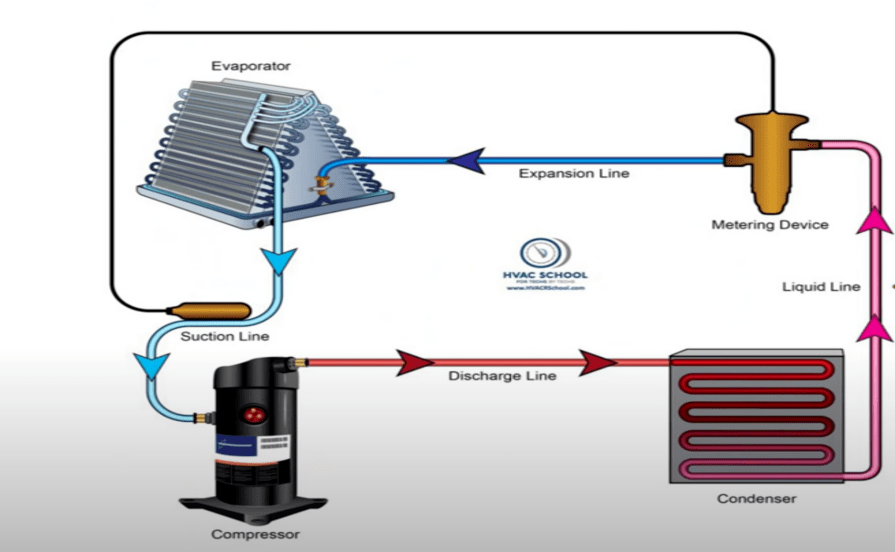
Liquid ammonia DX evaporator refrigeration is a very important part of the four components, low temperature condensate liquid through the evaporator, with the outside air heat exchange, gasification heat absorption, to achieve the cooling effect.
We are talking a little bit about liquid lines and discharge lines, some of the difference and some of the things to know about when you are measuring pressures and temperatures on both. So, to start with, your discharge line is the line that leaves your compressor and goes into your condenser. It is a high pressure, high temperature vapor. In most of your normal air conditioning applications, it is going to be somewhere between 160 and 225 degrees. It is going to be significantly higher temperature than your liquid line and it is going to be fully vapor. So, though they are both high pressure lines, one is going into the condenser, and one is going out of the condenser. The condenser is basically the heat rejector. So, it is job is to reject the heat out of the refrigerant, which then in turn changes its state, starting with fully vapor all the way down to fully liquid. So, if you imagine you have your discharge gas vapor goes into the top of the condenser and it works its way down.
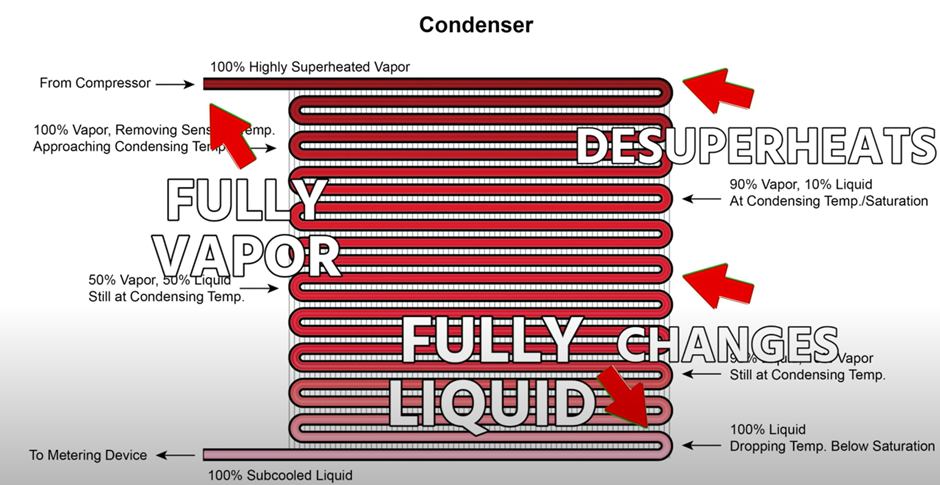
Now again, in this image, it shows a single pass. Condensers are generally multiple passes with headers, but it creates a liquid seal down at the bottom once it’s fully condensed. And that’s where we see sub cooling because sub cooling is the temperature decrease in refrigerant once it goes below that condensing temperature, or what we call our liquid saturation temperature. So when your refrigerant is at saturation, that means it’s still changing state from vapor to liquid. So it starts off fully vapor, the super heats, and then it goes into this phase where it’s changing once it drops below that. Now we know that it is fully liquid and our goal is to deliver a complete column of liquid to our metering device, which is why you’re generally going to see around ten degrees of sub cool. Now, you follow your manufacturer specifications, but around ten degrees of sub cooling. And that ensures that we’re going to deliver a full line of liquid to our metering device on our liquid line liquid line temperature. In general, your liquid line temperature is going to be about five to ten degrees warmer than your outdoor temperature.
If you take your outdoor temperature and you compare that to your liquid line temperature measured near the condensing unit, you should see that that liquid line temperature is five to ten degrees warmer than your outdoor temperature. A big thing to know is that you need to make sure you measure your liquid line temperature in the right place so that you don’t get confused, especially when there are liquid line dryers in the circuit.
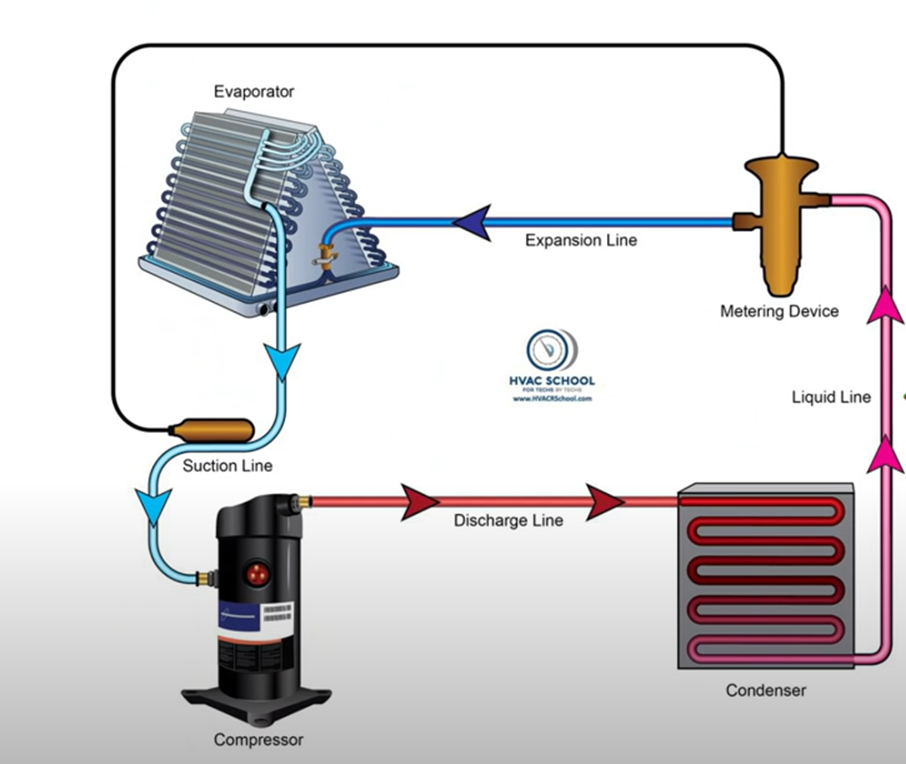
This sharp line from the compressor feeds into the top of the condenser, and then it’s multiple passes, but it comes together and it works its way down until you have a liquid seal at the bottom. And so when we’re looking at our liquid line pressure, we’re converting that to a condensing temperature. We’re comparing that to the physical temperature of the liquid line called the actual measured liquid line temperature. But if we were to measure on the other side of a liquid line dryer. We could potentially read in an accurate measurement because if this liquid line dryer has a pressure drop. That could result in a temperature change because the flash gas. Meaning changing state from liquid to vapor within the dryer.
liquid line temperature and pressure is used for subcooling your discharge line temperature
Evaporative Condenser
An evaporative condenser is used to remove excess heat from a cooling system when the heat cannot be utilized for other purposes. The excess heat is removed by evaporating water. The evaporative condenser has a cabinet with a water-sprayed condenser, and it usually has one or more fans.
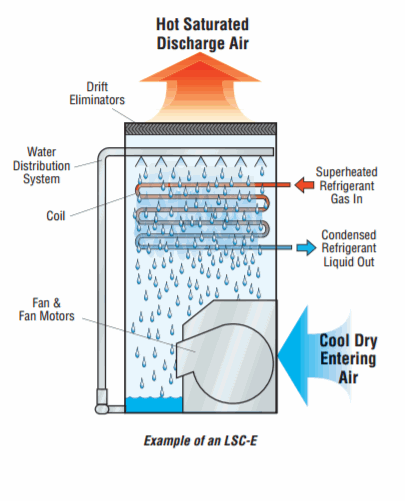
Wet Bulb Temperature: the wet bulb temperature represents the theoretical limit for how much we can cool water through evaporation
TX and Modulating valve: Both are expansion valve. TX are in Ammonia side and Modulating Valves are in Glycol Side
Multiple Compressor: Relation between compressors when the next compressor should engaged or disengaged is defined by Proportion minimum and maximum step/On and Step/Off timer with a common proportion band setting. If the and Individual upper and lower set points for step On and step Off are
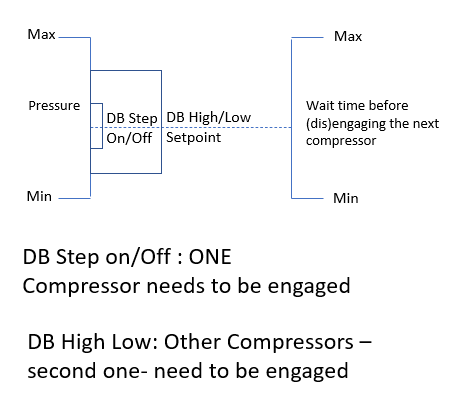
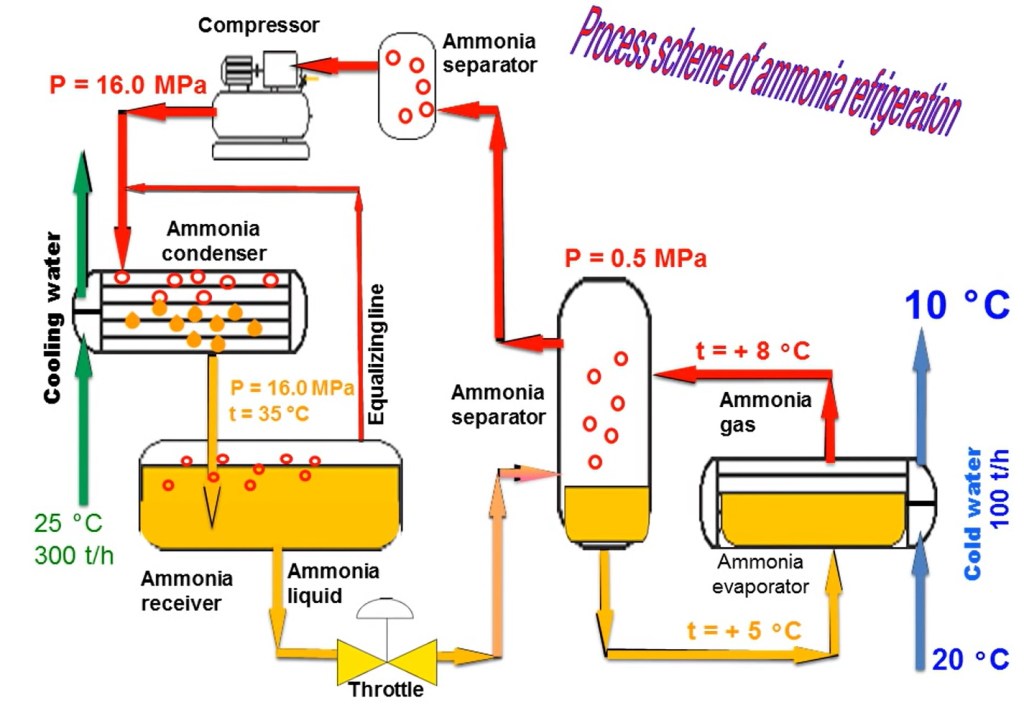
It could be Glycol instead of water, but as ammonia is dangerous gas can not be used in evaporator section (Rooms with people). so the heat must be transferred to a median like water or glycol
DDC
DDC stands for Direct Digital Control and is a type of energy management control system for HVAC systems. DDC systems use programmable electronic devices to monitor and control the heating, cooling, and ventilation. DDC systems are designed to help improve the energy efficiency and performance of the system.
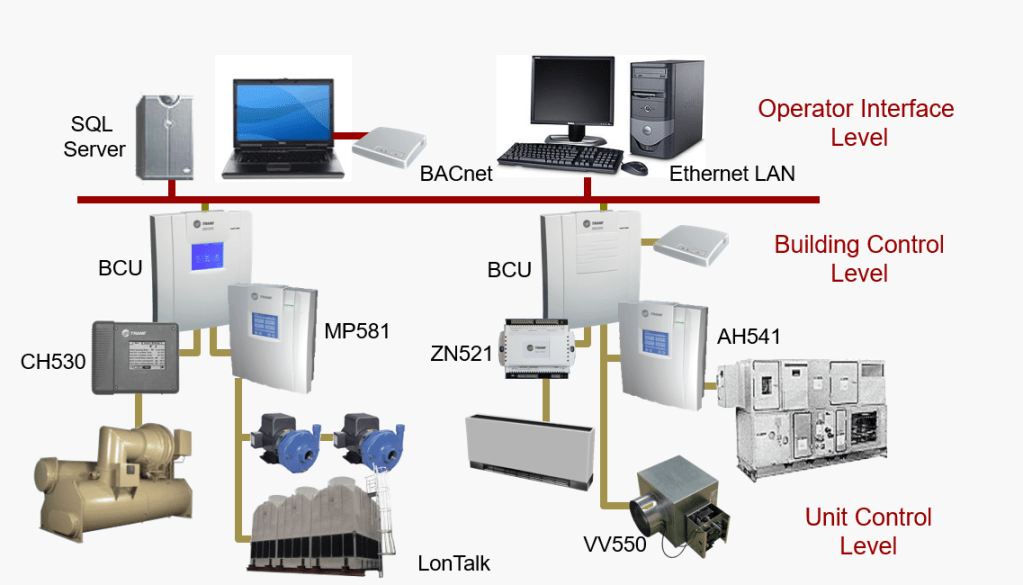
BCU stands for Building Control Unit and is a type of intelligent controller that is used in Building Automation Systems. It is responsible for monitoring and controlling the system components such as lights, fans, pumps, valves, and other devices in order to create an energy-efficient and safe environment.
Branch selector boxes (BSB) are used only with simultaneous heating and cooling heat recovery systems. Three pipes (suction gas, liquid, high/low-pressure gas) are run from the condensing unit to the BSB. Two pipes are then run from the BSB to the indoor unit(s).r.
Building Control (BC) Controller, The BC Controller houses a liquid/gas separator, allowing the outdoor unit to deliver a mixture (2-phase) of hot gas for heating and liquid for cooling, all through the same pipe.
ODU is Outdoor Unit and IDU is Indoor Unit
Power Distribution Indicator (PDI)
Damper Actuators are electric motors for positioning dampers in HVAC systems. Basically it control the amount of air flow in the system Low-cost, two-position actuators are also non-spring return direct coupled actuators. Dwyer’s models are designed to accept floating control signals and come in a variety of power supplies.
HVAC Process: Heating/Cooling/Humidification/DeHumidification/Cleaning/Ventilation/Air Movement
HVAC Component:
Source component (Compressor/Expansion Coil etc)
Distribution: Pumps/Valves etc
Delivery Component: Diffuser, Radiator etc
Control : Sensors, DDC
Central system is much bigger than local system
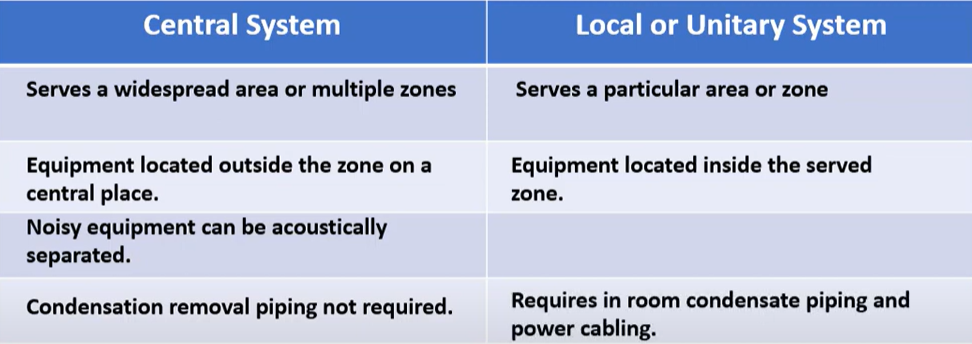
Single Zone:

Measuring for Billing
Heat/cooling energy meters collect energy consumption data for HVAC systems, such as boilers, chillers, heat pumps, and air-conditioning units. The meters typically measure the voltage, current, power, and energy consumed by the HVAC system. The data can be used to analyze energy consumption, identify potential cost savings, and track energy usage patterns over time. It can also be integrated with billing and the EMS system. Siemens’ WS.8 Energy Meter is an example; a multi-utility energy meter that measures the electricity, water, gas, and heat/cooling energy consumption of buildings. It features intelligent data logging, smart control, and integration with building automation systems for maximum energy efficiency.

 Electrical Engineer