
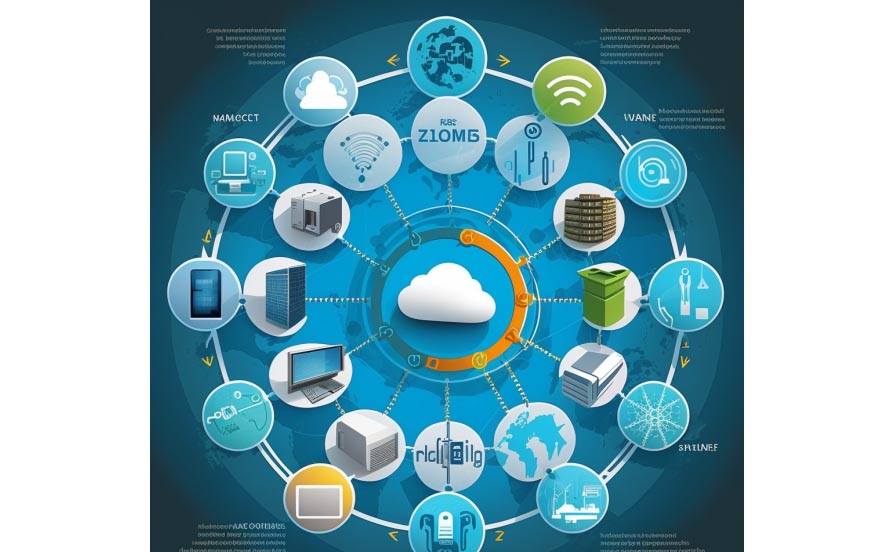
LPWA (Low-Power Wide-Area) is an emerging wireless communication technology that is designed to enable low-cost and low-power connectivity for the Internet of Things (IoT) and Machine-to-Machine (M2M) applications. It provides wide-area coverage and long battery life, making it an ideal technology for connecting devices in remote and rural areas.
NB-IoT (Narrowband-Internet of Things) is a low-power, wide-area network (LPWAN) technology specifically designed for the Internet of Things (IoT) and Machine-to-Machine (M2M) applications. It is typically used to connect devices in remote and rural areas where traditional cellular networks are unavailable. NB-IoT technology is a subset of the LTE (Long-Term Evolution) standard 4G wireless communication standard and is designed to provide low-power, low-cost and wide-area coverage.
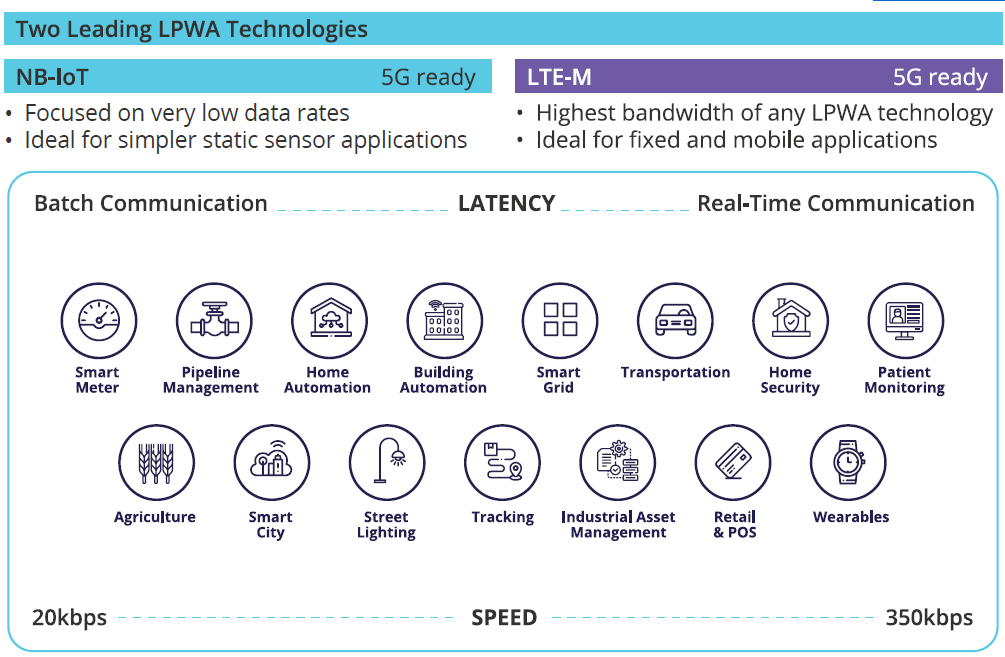
An APN (Access Point Name) is a gateway between a cellular network and the internet. It is used to provide access to the internet for devices connected to the cellular network. An APN consists of a network identifier, username, password, and other information required to connect the device to the internet.
The main difference between a private APN and a shared APN is that a private APN provides exclusive access to a secure network with dedicated bandwidth. This means multiple parties do not share the services on the network, and the bandwidth is never shared. A shared APN, on the other hand, gives multiple parties access to a shared network. As a result, the bandwidth is shared, meaning users on the shared network may experience slower speeds than those on a private network. In this context, “parties” refers to the individual or groups of people that have access to the private or shared network. For example, a private APN might be used by a business to provide access to a secure network only to its employees, while a shared APN might be used by multiple businesses to access a shared network, such as an LTE network.
IPsec : IPsec (Internet Protocol Security) is an Internet security protocol suite that provides secure communication and authentication between two or more participating parties

NAT (Network Address Translation) is a networking technique used to map multiple private IP addresses to a single public IP address. It is commonly used to allow devices on a private network (such as a home or office) to access the internet. NAT is used to conserve IP addresses, provide privacy and security and improve network performance.
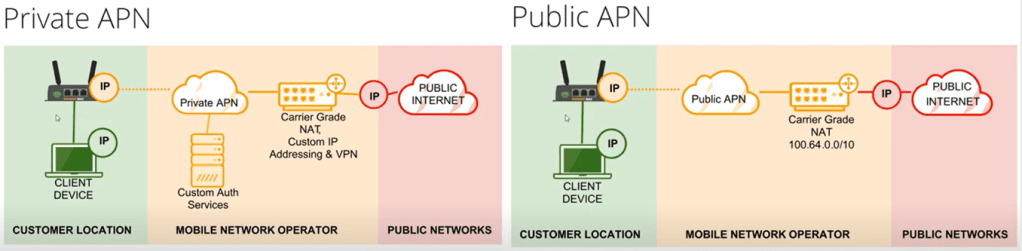
An IP address pool is a group of IP addresses assigned to a network or device. The device or network uses this group of IP addresses to establish connections to other devices or networks on the internet. IP address pools assign unique IP addresses to each device connected to the network, ensuring that each connection is secure and private.
IPSEC (IP Security) is a set of protocols to secure internet data communication.
An ICCID (Integrated Circuit Card Identifier) is a unique identifier used to identify a SIM card. It is a 19-digit number printed on the SIM card and used to identify it when inserted into a device.
Bluetooth LE is a version designed for lower-powered devices that use less data. Bluetooth LE remains in sleep mode to conserve power except when a connection is initiated. This makes it ideal for wearable fitness trackers and health monitors.
ZigBee is a 2.4 GHz mesh local area network (LAN) protocol. It was originally designed for building automation and control—so things like wireless thermostats and lighting systems often use ZigBee.
HAN or Home Area Network is a maximum 15m Zigbee network within a home that connects a Monitoring Device to a Smart Meter. Video
Z-Wave is a sub-GHz mesh network protocol, and is a proprietary stack. It’s often used for security systems, home automation, and lighting controls.
6LoWPAN uses a lightweight IP-based communication to travel over lower data rate networks. It is an open IoT network protocol like ZigBee, primarily used for home and building automation.
Thread is an open standard, built on IPv6 and 6LoWPAN protocols. You could think of it as Google’s version of ZigBee. You can use some of the same chips for Thread and ZigBee, because they’re both based on 802.15.4.
WiFi-ah (HaLow) Designed specifically for low data rate, long-range sensors and controllers, 802.11ah is far more IoT-centric than many other WiFi counterparts.
2G is the “old-school” TDMA (usually) cellular protocol. ATMs and old alarm systems used this— and in most parts of the world it is phased out or in the process of being phased out.
3G was the first “high speed” cellular network, and is a name that refers to a number of technologies that meet IMT-2000 standards.
4G is the generation of cellular standards that followed 3G, and is what most people use today for mobile cellular data. You can use 3G and 4G for IoT devices, but the application needs a constant power source or must be able to be recharged regularly.
LTE Cat 0, 1, & 3 LTE classes, the lower the speed, the lower the amount of power they use. LTE Cat 1 and 0 are typically more suitable for IoT devices.
NB-IoT, or Narrowband IoT, is another way to tackle cellular M2M for low power devices. It is based on a DSSS modulation similar to the old Neul version of Weightless-W. Huawei, Ericsson, and Qualcomm are active proponents of this protocol and are involved in putting it together.
LoRaWAN is a media access control (MAC) layer protocol designed for large-scale public networks with a single operator. It is built using Semtech’s LoRa modulation as the underlying PHY, but it is important to note that LoRa and LoRaWAN are two seperate things that are often (mistakenly) conflated.
The most common IoT network protocols include Wi-Fi, ZigBee, Z-Wave, Bluetooth, and LoRaWAN. Wi-Fi is the most widely used protocol, providing high bandwidth and reliable connections. ZigBee and Z-Wave are both low-power, low-bandwidth technologies that are great for small devices with limited power requirements. Bluetooth is a medium-range protocol that is good for short-distance communications. Lastly, LoRaWAN is a long-range protocol that is ideal for large-scale IoT deployments. Each protocol has its own advantages and disadvantages, and choosing the right one depends on the specific requirements of the application.
Cisco Jasper
Cisco Jasper is a cloud-based service that provides businesses with real-time visibility and control of their Internet of Things (IoT) devices. It offers cellular connection management, network analytics and optimization, usage-based billing, and secure data sharing. These features can help businesses save costs, reduce time-to-market, and simplify the management of their IoT deployments.
Cellular
Parameter Related to Range
Distance: Several parameters can greatly affect the effectiveness of a wireless network when it is set up. One key parameter is the distance between the sender and the receiver. As the distance increases, the signal strength decreases, leading to a weaker connection. You may need additional access points or repeaters if you have devices far apart, such as in a large office building or sprawling campus. This will ensure a strong and reliable connection throughout the area.
Line of Sight: Another key parameter is the line of sight between the sender and receiver. In a wireless network, obstacles such as walls, furniture, or even people can obstruct the signal and reduce its strength. This makes it important to consider the physical layout of the space when setting up the network. You can ensure that the signal reaches all devices by minimizing the number of obstacles or choosing strategic placement for access points. Additionally, if significant obstacles present, you may need to consider alternative solutions, such as using wired connections or implementing signal boosters to overcome these limitations.
Antenna: An important parameter in a wireless network is antenna type and adjustment. The antenna plays a crucial role in transmitting and receiving signals. Different antennas, such as omnidirectional or directional, have different transmission patterns and coverage areas. Choosing the right antenna type for your network can greatly impact its range and signal quality. Additionally, properly adjusting the antenna can optimize its performance. The antenna’s angle, tilt, and orientation can affect signal propagation. Adjusting the antenna correctly can eliminate dead zones, improve signal strength, and enhance wireless network coverage.
Power: Another parameter to consider is transmitter power. In Australia, for example, the regulation limits transmitter power to 20 dbm or 1 watt. Transmitter power directly affects the network’s range. Higher power can increase coverage area, leading to more interference and reduced signal quality. It is necessary to comply with regulatory limits while ensuring that the transmitter power is optimized for the specific environment and network requirements.
- dBi: A measure of antenna gain compared to an isotropic reference antenna.
- dBd: A measure of antenna gain compared to a dipole reference antenna.
- dBm: A measure of power referenced to 1 milliwatt.
- dB: A unit indicating the ratio of two quantities, commonly used to express logarithmic differences in power or intensity.
Lora
LoRa, which stands for “Long Range”, is a patented digital wireless data communication technology. Its primary allure lies in its ability to offer long-range communication with minimal power consumption. LoRa facilitates the creation of large-scale, low-power, and long-range networks, making it an ideal choice for the Internet of Things (IoT) and remote applications where traditional wireless systems might falter. With LoRa, devices can connect over vast distances, even in challenging environments, ensuring continuous communication without draining the battery.
Within a standard LoRaWAN setup, nodes (or end devices) communicate with internet-connected gateways, which then relay information to a network server. While direct node-to-node communication isn’t standard in LoRaWAN, it can be achieved using tools like the “RadioHead Packet Library”, allowing for more localized peer-to-peer communication without needing a gateway.
LoraWan is Bidirectional which means that Uplink is when the end node sends data to the gateway, and Downlink is when gateway sends data to the end node
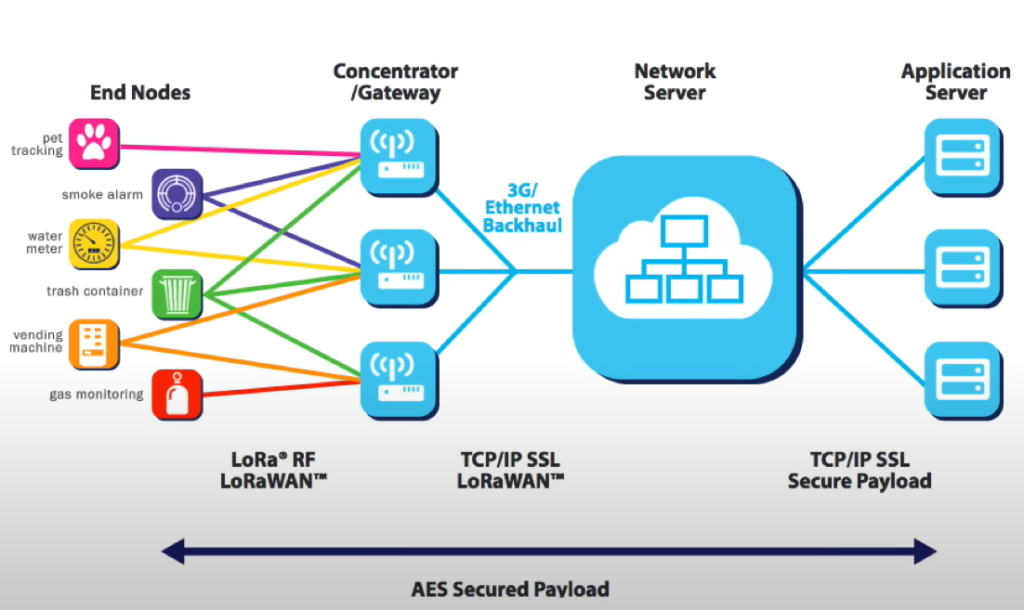
The Lora frequency is depends on the country. In australia it is 915 MHz to 930 MHz.
Class: Class A devices are battery-efficient, allowing for communication only after they send data, with two short receive windows.
Class B devices have scheduled receive windows, improving downlink communication efficiency at a slight cost to battery life.
Class C devices, sacrificing battery efficiency, are almost always open for downlinks, barring when they transmit data, making them suitable for applications requiring frequent server-to-node communication.
Lora VS LoraWan
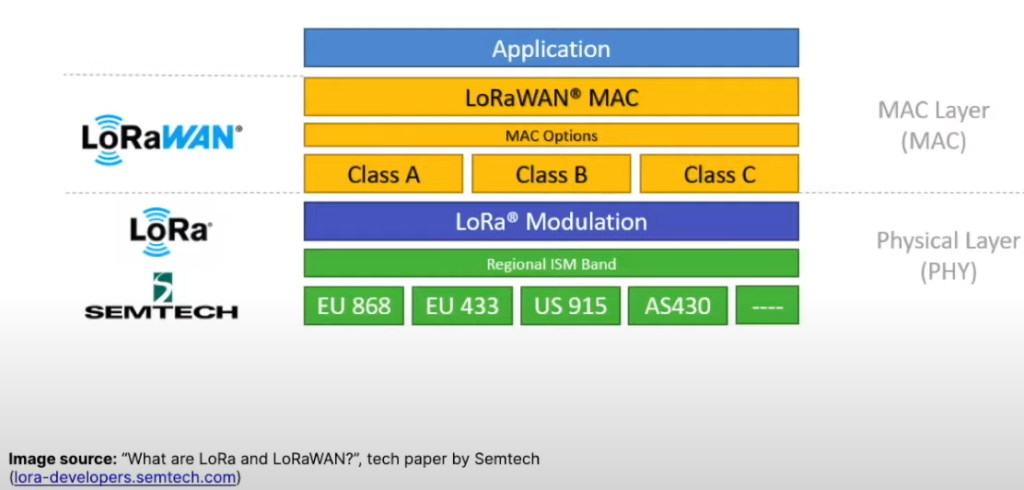
LoRa is a long-range, low-power wireless modulation technique used for communication at the physical layer, allowing devices to transmit data over vast distances with minimal energy consumption. LoRaWAN, on the other hand, is the communication protocol and system architecture built on top of the LoRa physical layer, defining how data is structured, secured, and communicated between devices, gateways, and central servers within a network. In essence, while LoRa is about “how” data is sent wirelessly, LoRaWAN is about “how” that data is processed and managed in a network setup.
Spreading factor (SF) is a parameter used in LoRa (Long Range) communication technology to control signal bandwidth, network transmission rate, and power usage. The higher the SF, the lower the network transmission rate and the wider the bandwidth. SF is set to optimize the data rate and distance of the network while minimizing power usage, to ensure reliable communication over long distances. SF is a numerical parameter (No Unit). It is typically set between 7 and 12, with 7 being the fastest and 12 being the slowest.
Lower SF -> Shorter range -> Less time on air -> Lower energy consumption -> Higher data rate
Adaptive data rate (ADR) is a mechanism used by LoRaWAN networks to ensure that the data rate of each device is optimized for the best information rate and network efficiency. It measures radio signal strength and uses that information to select the optimal data rate for each device. This helps ensure that devices send data at the best possible data rate and helps reduce network congestion.
Payload:
Payload limitation in LoRaWAN is defined by the maximum packet size sent from an end node to the gateway and is typically 51 to 242 bytes. This means that if an application requires more data to be sent, it needs to use multiple packets. The limitation is due to the LoRaWAN protocol’s physical layer data rate and message length limits. This small payload size means that devices send multiple packets when transmitting more data, which can increase latency and strain the network. Do not send json or csv.
In LoRaWAN, there are two ways to establish a session between a device and the network:ABP and OTAA.
ABP (Activation By Personalization), network credentials are hardcoded into the device, making it simpler but less secure, as it skips the join process.
OTAA (Over-The-Air Activation), the device and network perform a handshake using a join request and join accept process, dynamically generating encryption keys for a more secure connection. Both methods provide different trade-offs between security and simplicity.
in V1.0.x LoraWan APP key and Network Key created out of APP key. in V1.1.x there are 2 key , one for APP key and one for Network Key (NWkKey). the NWKKey include 3 key
Forwarding Network Session Integrity Check (FNwkSintKey)
Serving Network Session Integrity Key (SNWKSIntKey)
Network Session Encryption Key (NwkSEnckey)
The join Server is responsible for securely handling a device and network connection. Essentially, it acts like a “security guard” that checks credentials and grants access to the network.
Version:
Certification program for 1.0 already withdrawn
Certification against 1.0.1 soon to be ended (2021)
1.0.2 first stable version with many regions supported
1.0.3 – adds support for class B devices
1.1 – adds support for roaming between networks
The latest LoRaWAN specification released in 2020 → 1.0.4 (recommended)
1.1.1 coming soon: based on 1.1 with 1.0.4 clarifications

 Electrical Engineer