

Understanding billing in Australia is essential to keep track of their finances and provide customers with accurate and timely bills. With the help of automated billing platforms, organizations can ensure that their bills are current and accurate, resulting in greater customer satisfaction and more efficient financial management. Furthermore, an automated platform makes it easier to collect customer payments and reduces costs associated with manual billing. Understanding billing is an important step for any business operating in Australia.
Net metering is an electricity billing mechanism that allows consumers who generate some or all of their electricity to use it anytime instead of when it is generated.
NMI-National Meter Identifier
NMI stands for National Meter Identifier. It is a unique 11-digit number identifying an electricity or gas meter in Australia. It links billing information to the meter and can be found on electricity bills, meters, and installation boxes. Access to an NMI makes it much easier for companies to process bills and connect to the utility providers’ systems for billing.
In Australia, the NMI is typically issued by electricity or gas meter providers.
A Metering Provider must be accredited by and registered by AEMO. A Metering Provider must ensure that any metering equipment it installs is suitable for the range of operating conditions. A proper Meter is selected. Metering Data Provider (MDP) is An entity licensed to collect data from interruptible metering installations, such as large energy users, small energy users and virtual customers.
A Metering Data Provider must be accredited by and registered by AEMO. NMI is the National Metering Identifier (regardless of registration Categories) and is responsible for delivering metering data and relevant NMI Standing Data to Registered Participants and AEMO. Metering Provider (MP) is An entity responsible for installing, maintaining and replacing meters.
A Metering Coordinator is a person registered by AEMO who coordinates and provides metering services at a connection point. Metering Coordinator (MC) is An entity responsible for developing, implementing and managing a metering data exchange system to enable MDPs and MPs to exchange metering data accurately. The Metering Coordinator is also responsible for tracking energy usage by all metered customers in the exchange system and providing this information to end-users, such as energy retailers.
NMI-National Measurement Institute
A Certificate of Conformity and Verification (COCV) is required by the AEMO’s National Measurement Standard (NMS) for all utility meters used in the Australian energy market. This can be obtained from the National Measurement Institute (NMI) through their Pattern Approval process.
Gas-Meter-Electricity considered as utility and required NMI approved certificate. You can check the NMI pattern-approval HERE
NEM-12
NEM-12 format is a standardised document issued by electricity, gas or water meter providers in the National Electricity Market. It provides all of the meter-level data that is needed for billing purposes. It is a key document for service providers and customers. Electricity retailers and third-party providers can also use it to exchange data about the customer’s electricity or gas services. This data includes total usage, prices, charges, current and previous meter readings, and other essential billing data. NEM12 Retail Guide
By understanding NMI and NEM-12 format, companies can better manage their billing processes and provide accurate and timely bills to customers. This ultimately leads to more effective financial management and improved customer satisfaction.
Raw100: About the file itself, Format, When Created, By what Company
Raw200: About the Mter. NMI number, NMI Suffix, Metr register etc
Raw300: About the energy generated or consumed, if the meter support both it contain both that one of them which is B1 (produce energy ) would be 0 mostly. It shows the read quality whether it is actual or varied etc
Raw400: if the read quality is Varid then it shows the detail of not actual reading such as Substitute read or calculation method
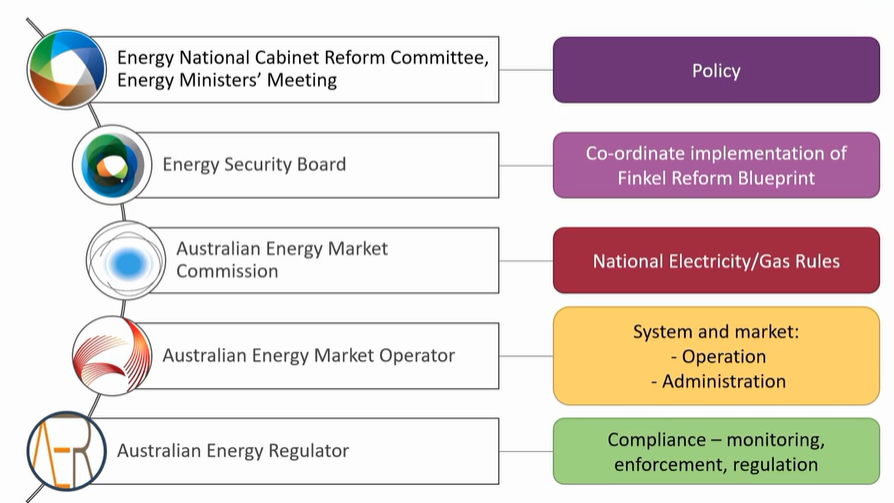
AEMO
NCC 2019 (National Construction Code of Australia 2019) Section 8.3 refers to the requirements for Facilities for energy monitoring
Meter Type
Meter types are important in determining the tariff(s) to which a customer can be assigned. The following four types of meters can be broadly classified:
Type 6: Basic accumulation meters (also known as Type 6 meters) – These meters measure only the total amount of electricity consumed over a period and are manually read by a meter reader. There are two types of meters within this category: those that record total usage within set periods (these can be aligned to a Time of Use tariff); and those that record only total usage. Most residential and small business meters within Essential Energy’s network area are this type of meter.
Type 5 meters – These meters record electricity consumption in 30 minute intervals and are manually read by a meter reader.
Type 1 to 4 meters: Meters with communication, Interval meters – These meters record how much electricity is used in every 30 minute interval and the associated demand. This allows customers to select a tariff that has different rates for usage at different times of the day. These meters have communications attached so are remotely read and are known as Type 1 to 4 meters.
4. Smart Meters (also known as Advanced Meters) – these meters record customer usage and demand in real time and are remotely read in 30 minute intervals. Smart Meters can be linked to in-home devices to allow customers to make informed decisions about their electricity consumption.
J8.3 NCC 2019
A building or sole-occupancy unit with a floor area of more than 500 m2 must have the facility to record the consumption of gas and electricity.
A building with a floor area of more than 2,500 m2 must have the facility to record individually the energy consumption of—air-conditioning plant including, where appropriate, heating plant, cooling plant and air handling fans; and artificial lighting; and appliance power; and central hot water supply; and internal transport devices including lifts, escalators and travelators where there is more than one serving the building; and other ancillary plant.
The provisions of (b) do not apply to a Class 2 building with a floor area of more than 2,500 m2 where the total area of the common areas is less than 500 m2.
Water Meter
Meters must meet the requirements. It includes NMI and WaterMark Certification.
Heat Meter
Heat meter billing refers to the process of measuring and charging for the energy used to produce heat, typically in residential or commercial buildings.

Heat meters are used to measure thermal energy transferred to heat water or spaces. This type of billing ensures that occupants are charged based on their actual energy consumption rather than a flat rate.
Meter to Billing Process Flow
- Meter Reading → 2. Data Collection → 3. NEM12 File Creation → 4. Data Validation → 5. Bill Calculation → 6. Bill Generation
Let’s examine each step in more detail:

1. Meter Reading
The interval meter records energy consumption data at regular intervals (typically every 30 minutes). The meter must be NMI Approved.
in Embedded network NMI is NOT compulsory
- NER Chapter 7: Metering
2. Data Collection
A Meter Data Provider (MDP) collects the raw meter data, either through remote reading or manual collection.
In the Embedded network The Embedded Network Manager (ENM) is responsible for meter reading within the network
- AS 62056 Series: Electricity metering – Data exchange for meter reading, tariff and load control
- NER 7.10: Metering Data
3. NEM12 File Creation
The MDP processes the raw data and creates a NEM12 file. A simplified example of a NEM12 file structure:
Required in embedded network for billing purpose
100,NEM12,202410141200,MDP1,RETAILER1 200,1234567890,E1,E1,METERNO01,kWh,30 300,20241014,10.5,11.2,9.8,10.1,10.3,10.7,A,20241014120000 … 900
- AEMO MDFF Specification NEM12 & NEM13: Version 1.06 (or latest version)4
- B2B Procedure: Technical Delivery Specification
4. Data Validation
The retailer receives the NEM12 file and validates the data for completeness and accuracy.
ENMs must ensure data accuracy for both on-market and off-market customers
- NER 7.11: Metering data and database
- AEMO Metrology Procedure: Part B
5. Bill Calculation
The retailer’s billing system processes the validated interval data, applying relevant tariffs and charges.
- In embedded network must comply with pricing regulations, although simplified according to regulation.
- National Energy Retail Rules (NERR): Part 2, Division 4 – Billing
- AER Retail Pricing Information Guidelines: Version 5.0 (or latest version)
6. Bill Generation
The final bill is generated, incorporating the calculated charges and any additional fees or discounts.This process ensures that the energy consumption data from the meter is accurately captured, standardized in the NEM12 format, and then used to create a bill for the customer. The NEM12 file serves as a crucial intermediary, providing a standardized format for communicating detailed interval meter data between market participants.
In embedded network must comply with pricing regulations,
Understanding your electricity bill
| Category | Name | Calculation | Description |
|---|---|---|---|
| Energy charges | Peak energy | Total energy consumed during peak time during the month x peak time tariff per kWh x DLF x MLF |
Cost per unit of energy consumed, measured in kilowatt hours (kWh) from the meter, and charged at peak, shoulder and off-peak rates. These charges reflect the costs (including retailer margin) of trading electricity on the wholesale market. Your retail contract primarily addresses these charges. Energy charges take into account the distribution loss factor (DLF) and the marginal loss factor (MLF). These two factors are calculated by the network service provider and published annually by the Australian Energy Market Operator (AEMO). |
| Shoulder energy | Total energy consumed during shoulder time during the month x shoulder time tariff per kWh x DLF x MLF |
||
| Off-peak energy | Total energy consumed during off-peak time during the month x off-peak time tariff per kWh x DLF x MLF |
Metering Processes in Two Scenarios
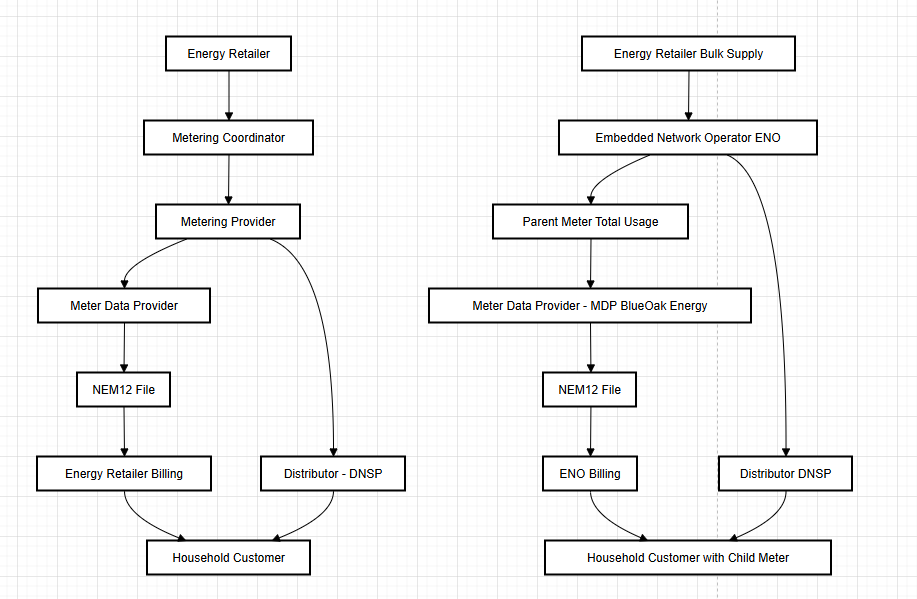
Below diagrams show the flow of energy billing and metering processes in two scenarios: a standard energy retailer setup and an embedded network operator (ENO) arrangement. In the standard setup (left), energy retailers rely on metering coordinators and providers to gather data via Meter Data Providers (MDPs), which generate NEM12 files used for billing household customers. In contrast, the ENO setup (right) consolidates bulk energy supply for multiple households using a parent meter, with MDPs like BlueOak Energy managing data for individual child meters.
Sample consultation documen
Electricity Metering Requirements for an Off-Market Embedded Network in a Queensland Skyscraper
I. Introduction to Embedded Electricity Networks in Australia
An embedded electricity network represents a private distribution system for electricity established within a larger property, such as the mixed-use skyscraper in question. This infrastructure enables the owner of the site to procure electricity in bulk from a main grid connection and subsequently on-sell it to the various tenants—residents and commercial entities—through individually installed meters.1 This arrangement typically involves a single point of connection to the public electricity grid, often referred to as a parent meter, which measures the total electricity supplied to the entire building. From this central point, the electricity is then distributed throughout the property to individual units, each equipped with its own sub-meter, also known as a child meter, to record the specific consumption of each tenant.1
The primary advantage for the building owner in establishing an embedded network lies in the potential for reduced electricity costs through the economies of scale associated with bulk purchasing.1 By negotiating a single, large-volume electricity supply contract, the owner may secure more favorable rates compared to what individual tenants might obtain directly from retail electricity providers. It is important to note, however, that while the owner benefits from this bulk purchasing power, there is no guarantee that these cost savings will be fully passed on to the tenants in the form of lower electricity bills.5 The price at which the owner, acting as an exempt seller, on-sells the electricity is a matter determined by them, subject to regulatory constraints.
In the specific case outlined, the embedded network is described as “off-market.” This designation indicates that the network operates under specific exemptions from the full licensing requirements that apply to traditional electricity retailers.1 In such a setup, the building owner assumes the role of an exempt seller, responsible for billing tenants based on their individual meter readings. These types of networks in Australia are subject to regulations established by the Australian Energy Regulator (AER), with implementation and oversight within Queensland often involving the state’s distribution network service providers, such as Energex and Ergon Energy.13 Operating under an off-market arrangement places direct responsibility on the building owner for tasks such as billing and potentially the ongoing management of the electricity network infrastructure without the direct market interaction that occurs when each tenant has their own retail electricity account. As an exempt seller, the building owner must adhere to the AER’s Retail Exempt Selling Guideline, which includes conditions related to pricing transparency, the provision of essential information to tenants, and established procedures for handling disputes.
The core of the user’s inquiry concerns the specific electricity metering requirements for the diverse mix of units within the skyscraper, encompassing over 600 residential apartments, 50 commercial office spaces, and 10 retail stores. The primary questions revolve around the necessity of assigning National Meter Identifiers (NMIs) to each meter, the appropriate meter class for accurate billing (with a specific query about the suitability of Class 2 meters), and the types of meters that would be suitable for this combination of residential and commercial premises. It is important to emphasize that the focus of this analysis is on the individual electricity meters installed within each unit and not on the authority meter that serves as the single connection point for the entire embedded network to the main electricity grid.
II. National Meter Identifier (NMI) Requirements
A National Meter Identifier (NMI) is a unique reference number, typically consisting of 10 or 11 digits, that serves to identify each and every electricity connection point within the National Electricity Market (NEM).7 This identifier plays a critical role in facilitating transactions within the electricity market, including the process by which consumers can switch between different electricity retailers.5 In essence, a NMI functions as the specific address for an electricity meter within the broader national energy grid system. Just as a physical property address ensures that postal mail reaches the correct location, an NMI ensures that electricity usage data is accurately attributed to the correct meter for the purposes of billing and market operations.
For an embedded network operating off-market, where the tenants do not have direct contractual relationships with retail electricity providers, the assignment of NMIs to the individual units is not strictly mandatory for the primary purpose of the building owner’s internal billing processes [based on the provided snippets]. The owner has the flexibility to utilize their own internal meter identifiers within their billing system to track and charge tenants for their electricity consumption.
However, the implementation of the Power of Choice reforms, which came into effect in December 2017, has significantly altered the landscape for customers residing within embedded networks.3 These reforms grant customers in such networks the right to choose their own electricity retailer, provided that a retailer is willing to offer them a supply contract. To exercise this right and engage with a retailer in the competitive market, a tenant requires a NMI associated with their individual meter. This unique identifier is typically allocated by an Embedded Network Manager (ENM).5
Therefore, while not an immediate necessity for the building owner’s billing operations, proactively ensuring that NMIs are assigned to each unit within the skyscraper offers a significant advantage by facilitating the future ability of tenants to choose their own electricity retailer should they wish to do so. If the building owner anticipates that tenants may, at some point, desire to access the broader retail market, establishing NMIs for each unit from the outset can greatly simplify this process.6
Furthermore, the appointment of an ENM becomes necessary under specific conditions, particularly if the embedded network serves 30 or more customers or when a customer within the network expresses a desire to enter into a contract with an external electricity retailer.5 Given the scale of the user’s development, comprising over 600 residential units, 50 commercial offices, and 10 retail stores—totaling more than 660 individual customers—it is highly probable that appointing an ENM is a mandatory requirement under the AER’s conditions for exemption from holding a full retail authorisation.5 The sheer number of units necessitates the engagement of an ENM to manage the interface between the embedded network and the broader National Electricity Market, particularly in facilitating potential transitions for tenants who wish to become on-market customers. Planning for this potential on-market access now can prevent the need for future retrofitting of metering infrastructure or other complications that might arise when tenants decide to pursue their right to choose an alternative electricity retailer.
III. Meter Class Requirements
Meter classes are used to define the accuracy standards of electricity meters, with higher class numbers generally indicating a wider permissible range of error, meaning lower accuracy. For revenue metering, which is the basis for billing customers, maintaining an appropriate level of accuracy is of paramount importance. The meter class essentially ensures that the measurement of electricity consumption is sufficiently precise to allow for fair and equitable billing.23 If a meter does not meet the required accuracy standards, it can lead to inaccuracies in billing, potentially resulting in either overcharging tenants, which can lead to disputes and erode trust, or under-recovering costs for the building owner, impacting the financial viability of the embedded network operation.
The provided research material does not offer a definitive recommendation for or against the use of Class 2 meters in this specific scenario. The now-obsolete Queensland Electricity Metering Manual (QEMM) placed a strong emphasis on high accuracy, particularly for installations utilizing current transformers (CTs), specifying a requirement for Class 0.5S CTs.23 This suggests a historical precedent for demanding a high degree of accuracy in metering for billing purposes.
The current prevailing standard for metering installations is the National Metering Installation Requirements (MIRs) Version 2.0.16 This document emphasizes the necessity of adhering to the National Electricity Rules (NER) and recognizes the electricity retailer’s responsibility for all aspects of metering for on-market customers. While the MIRs mandate the use of NER-compliant smart meters for all new and upgraded metering installations 16, they do not explicitly detail specific meter class requirements for every type of meter used in all situations. The MIRs serve as the primary document to consult for the current meter class requirements applicable to both direct connect meters and those used in conjunction with current transformers within embedded networks. The transition from the QEMM to the MIRs signifies an evolution in the regulatory landscape for metering standards, and the MIRs, being the current national benchmark, would contain the most pertinent information regarding acceptable meter classes for the user’s application.
The suitability of a specific meter class, such as Class 2, for the residential and commercial units in the skyscraper will likely depend on the detailed specifications outlined within the National Metering Installation Requirements (MIRs) and potentially any specific guidelines or interpretations provided by Energex or Ergon Energy in Queensland. For metering installations that utilize Current Transformers (CTs), which might be the case for the larger commercial and retail units with higher electricity consumption, the QEMM previously mandated Class 0.5S CTs.23 While the MIRs now govern these requirements, it is reasonable to anticipate that they would similarly specify high-accuracy classes for revenue metering applications involving CTs to ensure precise measurement of larger energy flows.16
For direct connected meters, which are likely to be used for the residential units and potentially smaller commercial office spaces, the research snippets do not explicitly state a required meter class. However, they do emphasize the need for these meters to be NEM compliant and, in most cases, to be smart meters.16 The specific accuracy requirements for these smart meters would be defined within the MIRs. While a Class 2 meter might potentially meet the minimum requirements for these types of installations, this would need to be verified against the detailed specifications contained within the MIRs document to ensure regulatory compliance and accurate billing. The accuracy demands for direct connect smart meters serving residential and smaller commercial customers might differ from those for CT-connected meters used by larger commercial or retail tenants due to the varying scales of energy consumption.
IV. Meter Type Requirements
A variety of electricity meter types are available, each with different functionalities and suitability for specific applications. Common types include:
- Accumulation Meters: These are the most basic type, measuring the total amount of electricity consumed over time.25 They can be either electronic with a digital display or electromechanical with a spinning disc and dials. However, these types of meters are generally being phased out and replaced by more advanced smart meters.27
- Interval Meters: These meters record electricity usage at predetermined intervals, typically every 30 minutes. This capability allows for the implementation of time-of-use tariffs, where electricity is charged at different rates depending on the time of day it is consumed.15 All interval meters are electronic. Smart meters are a more advanced form of interval meter.
- Smart Meters: These represent the most advanced type of electricity meter, offering the functionality of interval meters along with remote communication capabilities.15 This remote communication enables automated meter reading, eliminating the need for manual checks, and can also support more sophisticated tariffs, demand-based billing, and potential integration with smart grids and home energy management systems. Smart meters are now the standard type of meter installed for new connections and meter replacements within the NEM.
Given the current regulatory environment and the clear trend towards the adoption of smart metering technology, smart meters (often referred to as Type 4 meters) are the most suitable and likely mandatory meter type for the residential units within the skyscraper.15 These meters provide the necessary accuracy for billing and can support various tariff structures, including potential time-of-use options that might be beneficial for residents.
Similarly, the commercial offices and retail units within the development will also require smart meters, particularly if their energy consumption is significant. For the larger commercial and retail spaces, which are likely to have higher energy demands, interval meters or smart meters specifically designed to handle higher electrical loads and potentially used in conjunction with current transformers (CTs) might be necessary to ensure accurate measurement.16 The specific requirements for these types of installations would be detailed in the National Metering Installation Requirements (MIRs). The type of meter chosen should align with the expected energy consumption profile of each tenancy and any potential need for advanced metering features, such as demand measurement, which is often relevant for commercial tenants.4 Smart meters typically possess the capability to measure and record demand in addition to total energy consumption.
Furthermore, it is crucial to consider Queensland’s specific regulatory framework regarding electricity sub-metering. For new multi-unit residential (classified as Class 2) and office (classified as Class 5) buildings, the installation of electricity sub-meters for each individual unit or storey is mandatory.30 The user’s skyscraper, being a combination of residential and commercial units, falls under these classifications. These sub-meters must be installed in an easily accessible common area and must be clearly labeled to identify the specific unit or storey they serve.30 Compliance with these sub-metering regulations is essential for obtaining the necessary building approvals and ensuring a fair and transparent billing process for all tenants.
Therefore, for all types of units within the skyscraper—residential, commercial office, and retail—the recommended meter type is a smart meter (Type 4). This aligns with the prevailing national standards and the specific regulatory requirements for new electrical installations.15 Smart meters offer the benefits of accurate interval-based billing, remote meter reading capabilities, and the potential for future integration with advanced energy management systems, making them the most suitable choice for this modern mixed-use development.
V. Queensland Regulatory Framework for Embedded Network Metering
The Queensland Electricity Connection Manual (QECM) has historically been a key document outlining the standards and procedures for electrical installations, including metering, within Queensland.23 However, a significant shift in the regulatory landscape has occurred with the replacement of the QECM by the National Metering Installation Requirements (MIRs). This transition began in February 2024, and the QEMM is slated to become entirely obsolete by August 2024.32 Consequently, the MIRs now serve as the primary source of technical standards for electricity metering in Queensland. The MIRs are designed to foster a consistent approach to metering arrangements across the entire National Electricity Market (NEM).16 Given this recent change, the recommendations in this report will primarily reference the MIRs as the current and authoritative standard for metering requirements applicable to the user’s embedded network in Queensland.
In Queensland, the distribution network service providers responsible for the physical electricity infrastructure are Energex, which serves South East Queensland (including Brisbane, where a large skyscraper is likely to be located), and Ergon Energy, which covers regional Queensland.2 Considering the likely urban location of a large skyscraper in Australia, Energex would be the relevant distributor in this case. While the Power of Choice reforms have shifted the responsibility for the installation and maintenance of electricity meters for on-market customers to the retailers 16, Energex still retains a crucial role in managing network connections and the overall electricity infrastructure within its distribution service area.2 Therefore, it would be prudent to consult Energex directly, or their website resources, to obtain any specific guidance they might offer regarding metering requirements for embedded networks within their service territory. This is particularly relevant for understanding connection standards and any local interpretations or additional requirements that might supplement the national MIRs.2 Their frequently asked questions (FAQs) specifically aimed at owners and operators of embedded networks could also provide valuable insights.2
The Australian Energy Regulator (AER) plays a central role in governing embedded networks through the issuance of the Electricity Network Service Provider Registration Exemption Guideline and the Retail Exempt Selling Guideline.6 These guidelines outline the conditions under which an entity can operate an embedded network without being fully registered as a network service provider or a retail electricity provider. A key aspect of these guidelines is the emphasis on the necessity of using NEM-compliant electricity meters for any customers within the embedded network who wish to exercise their right to choose their own electricity retailer.13 The AER’s guidelines cover a wide range of factors relevant to embedded networks, including metering standards, pricing principles, the rights and obligations of customers, and the requirements for appointing an Embedded Network Manager (ENM). As the building owner will be operating as an exempt seller within an off-market embedded network, adherence to these AER guidelines is of paramount importance for maintaining their exempt status and avoiding potential regulatory penalties. Furthermore, these guidelines directly impact the rights of the tenants within the embedded network, including their potential access to retail choice, which in turn has implications for the types and specifications of the electricity meters that should be installed.
VI. Recommendations for Metering Infrastructure
Based on the analysis of the user’s requirements and the relevant regulatory framework, the following recommendations are provided for the electricity metering infrastructure in the skyscraper:
- It is recommended to assign National Meter Identifiers (NMIs) to each of the 600+ residential units, 50 commercial offices, and 10 stores from the outset. While not strictly necessary for the building owner’s billing within an off-market network, this proactive step will enable tenants to access the retail electricity market in the future should they choose to do so, aligning with the intent of the Power of Choice reforms. Given the large scale of the development, comprising over 660 customers, the appointment of an Embedded Network Manager (ENM) is likely a mandatory requirement under the AER’s exemption conditions.5
- For the residential units, it is recommended to install smart meters that fully comply with the accuracy requirements specified in the National Metering Installation Requirements (MIRs). Further detailed investigation into the specific class requirements within the MIRs for residential revenue metering is necessary. However, given the regulatory mandate for smart meter installations for new connections 27, this is the most appropriate meter type to ensure compliance and future functionality.
- For the commercial offices and retail units, it is also recommended to install smart meters that have sufficient capacity to accurately measure their anticipated energy consumption. For the larger commercial and retail spaces that are likely to have higher electricity demands, the use of CT-connected smart meters should be considered to ensure the accurate measurement of these higher loads.16 It is crucial to consult the MIRs to determine the required accuracy class for commercial revenue metering, as this may differ from the requirements for residential units. To minimize the potential for billing disputes, it is prudent to aim for a high accuracy class, such as Class 0.5S or better for CTs, consistent with the standards previously outlined in the QEMM.
- For all types of units within the skyscraper (residential, commercial office, and retail), the recommended meter type is a smart meter (Type 4). This choice aligns with the current national trend and the regulatory requirements for all new electricity meter installations.15 Smart meters offer the advantages of accurate interval billing, remote meter reading capabilities, and the potential for future integration with advanced energy management systems.
- To ensure compliance with Queensland’s regulations regarding electricity sub-metering, individual smart meters must be installed for each residential unit, commercial office, and retail store. These meters should be located in easily accessible common areas, and each meter must be clearly labeled to identify the specific unit it serves, in accordance with the requirements of the Queensland Development Code 4.1—Sustainable buildings (QDC 4.1).30
- It is imperative to ensure that all aspects of the metering infrastructure, including the selection of meters and the installation practices, fully comply with the latest version of the National Metering Installation Requirements (MIRs).32
- The Queensland Electricity Connection Manual (QECM) should be consulted for any relevant standards or local requirements specific to Queensland regarding the connection of the embedded network to the main electricity grid.32
- Finally, the building owner, as the operator of an off-market embedded network and an exempt seller of electricity, must adhere to all relevant conditions and requirements outlined in the Australian Energy Regulator’s Electricity Network Service Provider Registration Exemption Guideline and Retail Exempt Selling Guideline to maintain regulatory compliance.47
VII. Conclusion
Establishing the correct electricity metering infrastructure is a fundamental requirement for ensuring accurate billing and the efficient operation of the embedded network within the user’s mixed-use skyscraper. While the assignment of NMIs to individual units is not strictly mandated for the owner’s off-market billing purposes, it is strongly recommended as a proactive measure to facilitate potential future access to the retail electricity market for tenants. Given the size of the development, the appointment of an ENM is likely necessary. The appropriate meter class for both residential and commercial/retail units should be determined by careful consultation of the National Metering Installation Requirements (MIRs) to guarantee compliance and billing accuracy. Smart meters are the recommended meter type for all units due to their advanced functionality and alignment with current industry standards and regulatory trends. Adherence to the MIRs, the QECM (for connection standards), and the AER’s guidelines for exempt embedded networks is essential for ensuring regulatory compliance and the long-term viability of the electricity supply arrangement within the building.
Table 1: Recommended Metering Requirements by Unit Type
| Unit Type | NMI Required | Recommended Meter Class | Recommended Meter Type | Location of Meter | Labeling Requirement |
| Residential Unit | Yes | Smart meter compliant with MIRs; further investigation needed for specific class | Smart Meter (Type 4) | Accessible common area | Yes |
| Commercial Office | Yes | Smart meter compliant with MIRs; further investigation needed for specific class | Smart Meter (Type 4) | Accessible common area | Yes |
| Store | Yes | Smart meter compliant with MIRs; further investigation needed for specific class | Smart Meter (Type 4) | Accessible common area | Yes |
Table 2: Relevant Regulatory Documents and Guidelines
| Document/Guideline Name | Issuing Authority | Relevance to Embedded Network Metering | Key Aspects Covered | Current Version/Effective Date | Link to Document |
| National Metering Installation Requirements (MIRs) | Competitive Metering Industry Groups (CMIG) | Sets the technical standards for metering installations in the NEM, including Queensland. | Installation, maintenance, testing, and accuracy of meters. | V2.0, effective February 2024 | (https://www.masterelectricians.com.au/wp-content/uploads/2024/05/CMIG-MIR-V2.0-Final.pdf) |
| Queensland Electricity Connection Manual (QECM) | Energex and Ergon Energy | Provides standards for connecting electrical installations to the distribution network in Queensland. | Connection requirements, metering installation (though being replaced by MIRs). | Version 4, effective February 2024 | https://www.ergon.com.au/__data/assets/pdf_file/0008/1170953/Queensland-Electricity-Connection-Manual-Version-4-2912908.pdf |
| Electricity Network Service Provider Registration Exemption Guideline | Australian Energy Regulator (AER) | Outlines conditions for exemption from registering as a network service provider. | Metering, AEMO requirements, pricing, ENM appointment. | Version 6, March 2018 (Review underway) | https://www.aer.gov.au/industry/registers/resources/guidelines/network-service-provider-registration-exemption-guideline-march-2018 |
| Retail Exempt Selling Guideline | Australian Energy Regulator (AER) | Sets out the AER’s approach to granting exemptions from the requirement to hold a retailer authorisation. | Customer rights, pricing, hardship policies, information provision. | Version 6, July 2022 (Draft Version 7 released March 2025) | https://www.aer.gov.au/industry/registers/resources/guidelines/retail-exempt-selling-guideline-july-2022 |
| Queensland Development Code—4.1 Sustainable buildings (QDC 4.1) | Queensland Government | Mandates electricity sub-metering for new multi-unit residential and office buildings. | Requirement for sub-meters, location, labeling. | (Refer to Queensland Government website for latest version) | https://www.epw.qld.gov.au/__data/assets/pdf_file/0021/5754/electricitysubmeteringfactsheet.pdf |
| Embedded Network FAQs for Owners/Operators | Energex | Provides answers to common questions regarding embedded networks from an operator’s perspective in the Energex service area. | Metering, connections, responsibilities. | 08/09/2023 | https://www.energex.com.au/__data/assets/pdf_file/0009/1082925/Embedded-Network-Operator-FAQs.pdf |
Works cited
- Embedded Networks – Locality Energy, accessed on May 20, 2025, https://www.localityenergy.com.au/community-energy-solutions/embedded-networks/
- Connection information for embedded networks – Energex, accessed on May 20, 2025, https://www.energex.com.au/our-services/connections/residential-and-commercial-connections/solar-connections-and-other-technologies/connection-information-for-embedded-networks
- Electricity for residents of multi-unit complexes | Homes and housing, accessed on May 20, 2025, https://www.qld.gov.au/housing/buying-owning-home/energy-water-home/electricity/electricity-prices/multiunit-complexes-electricity
- Embedded networks | Business Queensland, accessed on May 20, 2025, https://www.business.qld.gov.au/running-business/energy-business/energy-pricing/embedded-networks
- Embedded Networks 101: ENM vs ENO – What is the Difference?, accessed on May 20, 2025, https://www.enmsolutions.com.au/industry-insight/embedded-networks-101-enm-eno-difference
- Power of Choice and embedded networks – there’s no need to jump ship! – Energetics, accessed on May 20, 2025, https://www.energetics.com.au/insights/thought-leadership/power-of-choice-and-embedded-networks-theres-no-need-to-jump-ship
- Embedded Networks Explained – WINconnect, accessed on May 20, 2025, https://www.winconnect.com.au/embedded-networks-explained/
- Embedded networks customers | Australian Energy Regulator (AER), accessed on May 20, 2025, https://www.aer.gov.au/consumers/understanding-energy/embedded-networks-customers
- Embedded networks | EWOQ – Energy and Water Ombudsman Queensland, accessed on May 20, 2025, https://www.ewoq.com.au/members/embedded-networks
- The importance of knowing your obligations with Embedded Energy Networks, accessed on May 20, 2025, https://altogethergroup.com.au/about/who-we-are/news-media/the-importance-of-knowing-your-obligations-with-embedded-energy-networks/
- Embedded Networks Guide: Transform Your Energy Management – Watt Utilities, accessed on May 20, 2025, https://wattutilities.com.au/transforming-energy-management-implementing-embedded-networks/
- Decision Regulatory Impact Statement – Dispute resolution for residential embedded network customers – Queensland Treasury, accessed on May 20, 2025, https://s3.treasury.qld.gov.au/files/Decision-RIS-Dispute-resolution-for-residential-embedded-network-customers.pdf
- Embedded electricity networks | Business Queensland, accessed on May 20, 2025, https://www.business.qld.gov.au/industries/mining-energy-water/energy/electricity/embedded-electricity-networks
- Embedded Network Manager – Watts Energy, accessed on May 20, 2025, https://www.wattsenergy.com.au/our-services/embedded-network-manager/
- Electricity, gas and water meters | EWOV, accessed on May 20, 2025, https://www.ewov.com.au/fact-sheets/electricity-gas-water-meters
- National Metering Installation Requirements – Master Electricians Australia, accessed on May 20, 2025, https://www.masterelectricians.com.au/wp-content/uploads/2024/05/CMIG-MIR-V2.0-Final.pdf
- Embedded Networks and Power of Choice – ENM Solutions, accessed on May 20, 2025, https://www.enmsolutions.com.au/industry-insight/embedded-networks-power-of-choice
- Embedded Network Managers | Australian Energy Regulator (AER), accessed on May 20, 2025, https://www.aer.gov.au/embedded-network-managers
- How to access retailers for your energy needs if you live in an embedded network, accessed on May 20, 2025, https://www.aer.gov.au/system/files/Energy%20Locals%20-%20Submission%202%20to%20AER%20Retail%20Draft%20Guideline%20-%204%20April%202022.pdf
- Residential customers in embedded networks – RMS Energy, accessed on May 20, 2025, https://rmsenergy.com.au/wp-content/uploads/2019/11/7802_embedded-network-customer-residential-factsheet.pdf
- Embedded Networks – AEMC, accessed on May 20, 2025, https://www.aemc.gov.au/rule-changes/embedded-networks
- Embedded Electricity Networks | Simples! – Compare the Market, accessed on May 20, 2025, https://www.comparethemarket.com.au/energy/embedded-electricity-network/
- Queensland Electricity Metering Manual – Ergon Energy, accessed on May 20, 2025, https://www.ergon.com.au/__data/assets/pdf_file/0003/1015932/Queensland-Electricity-Metering-Manual-QEMM.pdf
- Competitive Metering Industry Group – Master Electricians, accessed on May 20, 2025, https://www.masterelectricians.com.au/competitive-metering-industry-group/
- Type of meters – Ausgrid, accessed on May 20, 2025, https://www.ausgrid.com.au/Your-Energy-Use/Meters/Type-of-meters
- Understanding your meter | EnergyAustralia, accessed on May 20, 2025, https://www.energyaustralia.com.au/home/bills-and-accounts/understanding-your-meter
- Digital meter installation | Homes and housing – Queensland Government, accessed on May 20, 2025, https://www.qld.gov.au/housing/buying-owning-home/energy-water-home/electricity/digital-meters/digital-meter-installation
- Residential electricity tariffs | Energex, accessed on May 20, 2025, https://www.energex.com.au/manage-your-energy/save-money-and-electricity/tariffs/residential-tariffs
- Metering charges | Energex, accessed on May 20, 2025, https://www.energex.com.au/our-services/metering/metering-charges
- Electricity sub-metering, accessed on May 20, 2025, https://www.epw.qld.gov.au/__data/assets/pdf_file/0021/5754/electricitysubmeteringfactsheet.pdf
- Electricity sub-metering for buildings | Business Queensland, accessed on May 20, 2025, https://www.business.qld.gov.au/industries/building-property-development/building-construction/laws-codes-standards/sustainable-housing/electricity-sub-metering
- Queensland Electricity Connection Manual (QECM) – Energex, accessed on May 20, 2025, https://www.energex.com.au/contractors/electrical-contractors/queensland-electricity-connection-manual-qecm
- Reviewing Queenslands connection and metering requirements – Talking Energy, accessed on May 20, 2025, https://www.talkingenergy.com.au/77078/widgets/371712/documents/231232
- Queensland Electricity Connection and Metering Manual – Ergon Energy, accessed on May 20, 2025, https://www.ergon.com.au/__data/assets/pdf_file/0004/1069312/NA000403R328-Ver-6-QECMM.pdf
- Queensland Electricity Connection Manual Version 4 – 2912908 – Ergon Energy, accessed on May 20, 2025, https://www.ergon.com.au/__data/assets/pdf_file/0008/1170953/Queensland-Electricity-Connection-Manual-Version-4-2912908.pdf
- Queensland Electricity Connection Manual (QECM) – Ergon Energy, accessed on May 20, 2025, https://www.ergon.com.au/__data/assets/pdf_file/0020/1015931/Queensland-Electricity-Connection-Manual-QECM.pdf
- National Metering Installation Requirements – Version 1.1 – Master Electricians, accessed on May 20, 2025, https://www.masterelectricians.com.au/wp-content/uploads/CMIG-MIR-V1.1-Sept-2020.pdf
- Contact Us – Energex, accessed on May 20, 2025, https://www.energex.com.au/contact-us
- Contact us – Ergon Energy, accessed on May 20, 2025, https://www.ergon.com.au/retail/contact-us
- guide to embedded networks – Australian Energy Market Operator, accessed on May 20, 2025, https://www.aemo.com.au/-/media/files/electricity/nem/retail_and_metering/accreditation/guide-to-embedded-networks.pdf?la=en
- CONSULTATION PAPER – Review of regulatory arrangements for embedded networks – AEMC, accessed on May 20, 2025, https://www.aemc.gov.au/sites/default/files/content/5991e6d2-df7d-4da4-897d-1c363ddf3f6c/Embedded-networks-review-consultation-paper-final.PDF
- Review of the AER exemption framework for embedded network: Draft decision, accessed on May 20, 2025, https://www.millsoakley.com.au/insights/review-of-the-aer-exemption-framework-for-embedded-network-draft-decision/
- Embedded networks in NSW, accessed on May 20, 2025, https://www.parliament.nsw.gov.au/ladocs/other/17541/Presentation%20by%20EWON%20on%20Embedded%20networks%20in%20NSW%20.pdf
- Review of regulatory arrangements for Embedded networks – Implementation of recommendations in Draft Report – Australian Energy Market Commission, accessed on May 20, 2025, https://www.aemc.gov.au/sites/default/files/content/e7a91675-0277-4757-9221-a59bf832a5e2/Embedded-networks-review-RPR0006-MinterEllison-report-published.pdf
- updating the regulatory frameworks for embedded networks – AEMC, accessed on May 20, 2025, https://www.aemc.gov.au/media/88098
- Network service provider registration exemption guideline review 2021–22 | Australian Energy Regulator (AER), accessed on May 20, 2025, https://www.aer.gov.au/industry/registers/resources/guidelines/network-service-provider-registration-exemption-guideline-review-2021-22
- Network service provider registration exemption guideline – March …, accessed on May 20, 2025, https://www.aer.gov.au/industry/registers/resources/guidelines/network-service-provider-registration-exemption-guideline-march-2018
- Guideline on Network Service Provider Classification and Exemptions – AEMO, accessed on May 20, 2025, https://wa.aemo.com.au/-/media/Files/Electricity/NEM/Participant_Information/New-Participants/Network-Service-Provider-Classification-and-Exemptions-Guide.pdf
- NER Clause 2.5.1: Registration as a Network Service Provider – AEMC Energy Rules, accessed on May 20, 2025, https://energy-rules.aemc.gov.au/ner/3/5303
- Updating the Electricity Network Service Provider – Registration Exemption Guideline (Network Exemption Guideline) – ENM Solutions, accessed on May 20, 2025, https://www.enmsolutions.com.au/industry-insight/updating-the-electricity-network-service-provider-registration-exemption-guideline-network-exemption-guideline
- Energy-On-AER-Conditions-for-Network-Exemption-Holders.pdf, accessed on May 20, 2025, https://www.energyon.com.au/assets/Uploads/Energy-On-AER-Conditions-for-Network-Exemption-Holders.pdf
- AER’s Network Exemption Guideline: Proposed Revisions and Considerations, accessed on May 20, 2025, https://www.enmsolutions.com.au/industry-insight/aers-network-exemption-guideline-proposed-revisions-and-considerations
- New Registration Exemption Guideline released – Compliance Quarter, accessed on May 20, 2025, https://www.compliancequarter.com.au/new-registration-exemption-guideline-released/
- Review of the AER’s Network and Retail Exemption Guidelines – Compliance Quarter, accessed on May 20, 2025, https://www.compliancequarter.com.au/review-of-the-aers-network-and-retail-exemption-guidelines/
- AER Publishes Updated Retail Exempt Selling Guideline – ENM Solutions, accessed on May 20, 2025, https://www.enmsolutions.com.au/industry-insight/aer-publishes-updated-retail-exempt-selling-guideline
- Draft Retail Exempt Selling Guideline (Version 6) March 2022 | Compliance Quarter, accessed on May 20, 2025, https://www.compliancequarter.com.au/draft-retail-exempt-selling-guideline-version-6-march-2022/
- The new Retail Exempt Selling Guideline – Compliance Quarter, accessed on May 20, 2025, https://www.compliancequarter.com.au/the-new-retail-exempt-selling-guideline/
- Retail exempt selling guideline – July 2022 | Australian Energy …, accessed on May 20, 2025, https://www.aer.gov.au/industry/registers/resources/guidelines/retail-exempt-selling-guideline-july-2022
- Updating the AER’s Retail Exempt Selling Guideline – ENM Solutions, accessed on May 20, 2025, https://www.enmsolutions.com.au/industry-insight/updating-the-aers-retail-exempt-selling-guideline
- Part 9 Exempt selling regime, accessed on May 20, 2025, https://www.aemc.gov.au/sites/default/files/content//NRR-v11-Part-09.PDF
- EVC response to AER retailer authorisation and exemption review issues paper | Electric Vehicle Council, accessed on May 20, 2025, https://electricvehiclecouncil.com.au/wp-content/uploads/2022/10/EVC-response-to-AER-retailer-authorisation-and-exemption-review-issues-paper.pdf
- AER (Retail) Exempt Selling Guideline November 2015 – Consumer Action Law Centre, accessed on May 20, 2025, https://consumeraction.org.au/wp-content/uploads/2015/11/AER-Retail-Exempt-Selling-Guideline-November-2015.pdf
- Retail Exempt Selling Guideline – Australian Energy Regulator (AER), accessed on May 20, 2025, https://www.aer.gov.au/system/files/2025-03/Draft%20Retail%20Exempt%20Selling%20Guideline%20%28version%207%29.pdf

 Electrical Engineer