
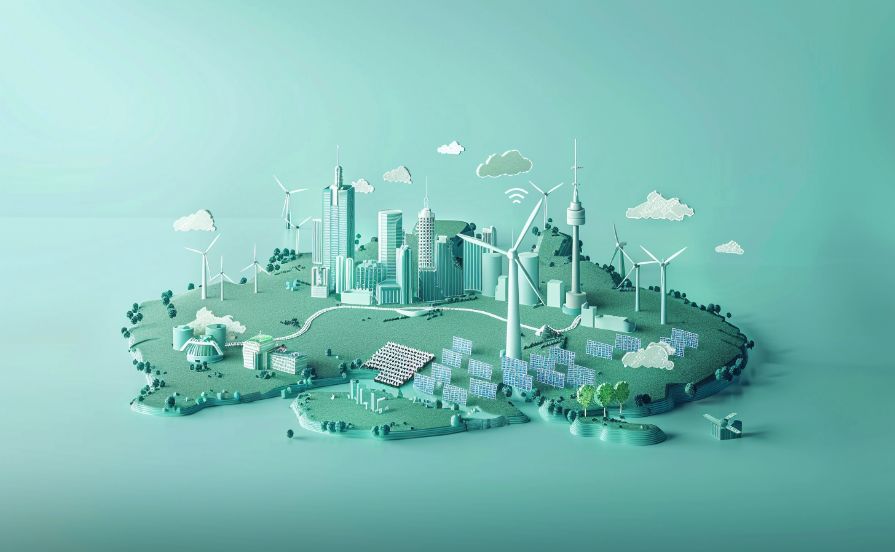
In the power market, electricity is generated at power plants using various energy sources such as fossil fuels, renewables, or nuclear energy. This power is transmitted over high-voltage transmission lines to substations, where the voltage is reduced for local distribution. From the substations, electricity travels through distribution lines to reach local communities. Between the distribution lines and the end users, retailers manage the supply, acting as intermediaries.
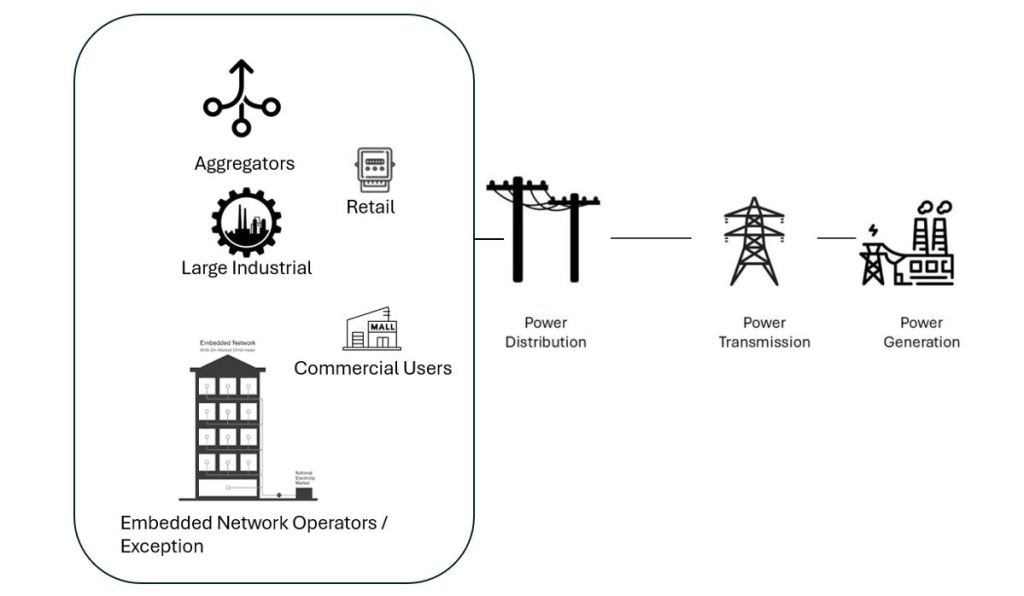
The electricity value chain comprises several key steps
- Acquire Fuel: This step involves procuring the primary energy sources needed for electricity generation, such as coal, natural gas, uranium, or renewable resources like wind and solar.
- Generate: Electricity is produced in this phase by converting fuel into electrical energy using generators in power plants.
- Transmit: Once generated, electricity is transmitted over long distances via high-voltage transmission lines.
- Distribute: In the final phase, electricity is distributed to consumers through a network of low-voltage distribution lines.
Energy Market
Capacity Market: Australia’s approach to ensuring power system reliability differs from traditional capacity markets used in some parts of the US and Europe. Here’s an overview of Australia’s system and how it compares to capacity markets:
Energy-Only Market
Australia primarily operates an energy-only market, where generators are paid for the electricity they produce rather than for maintaining capacity1. This approach aims to encourage efficient investment and operation of power plants based on market signals.
Retailer Reliability Obligation (Large User)
Instead of a traditional capacity market, Australia implemented the Retailer Reliability Obligation (RRO) in 2019. This mechanism requires electricity retailers and some large energy users to hold contracts or invest directly in dispatchable generation or demand response to support reliability during peak demand periods
Reliability and Emergency Reserve Trader.
The Australian Energy Market Operator (AEMO) can use the Reliability and Emergency Reserve Trader (RERT) mechanism to contract for additional capacity when a shortfall is forecast1. This acts as a safety net to maintain system reliability.
The capacity market does not exist in Australia, which means that no one pays for the size or capacity of the power plant. In other words, power plants are not paid simply for having capacity.
Retailer Reliability Obligation (RRO) is one mechanism designed to address the reliability gap that a capacity market would typically fill.
- Purpose of RRO: Ensures retailers and large users secure enough energy to cover peak demand and prevent supply shortfalls.
- AEMO’s Role: Forecasts reliability gaps and notifies the market when the RRO may need to be triggered.
- AER’s Role: Enforces compliance with the RRO once it is triggered, ensuring obligations are met.
- Contracting Parties: Contracts are between large consumers, retailers, and energy producers or capacity providers.
- Focus on Consumer Side: Contracts can include demand reduction, self-generation, or energy storage on the consumer side.
- Demand Response Option: Consumers can agree to reduce their usage during peak periods as part of their RRO strategy.
- Self-Generation and Backup: On-site generation can be used to meet demand and reduce reliance on the grid during peaks.
The other mechanism is Reliability and Emergency Reserve Trader. Under RERT, Reserve Providers get paid more only if they’re called upon in emergencies, but they aren’t paid to hold capacity on standby at all times.
- Purpose of RERT: Provides emergency backup supply to prevent grid shortfalls during critical periods.
- AEMO’s Role: AEMO manages RERT by forecasting shortfalls and contracting reserve providers as a last-resort option.
- Reserve Providers: Include energy production companies, demand response providers, battery storage operators, and aggregators.
- Activation in Emergencies: RERT is only activated when the regular market cannot meet reliability needs, making it an emergency-only service.
- Higher Costs for Activation: Reserve providers are paid more for supplying energy or reducing demand during RERT activation.
- No Regular Capacity Payment: Unlike a capacity market, RERT providers don’t receive standby payments; they are compensated only when needed.
- Cost Recovery: The costs of RERT are passed on to electricity users, covering the higher rates paid during emergency activations.
Ancillary Market
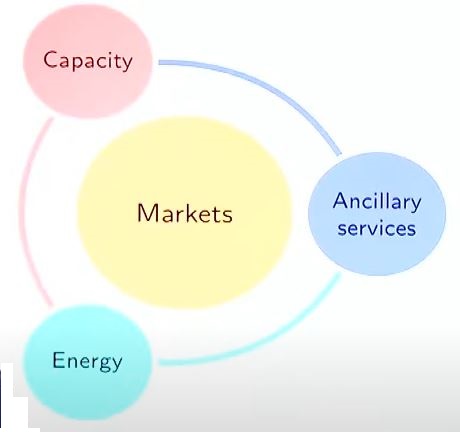
A key difference between ancillary services and capacity and energy markets is that ancillary services focus on real-time grid stability, whereas capacity and energy markets are forecast-based.
In the Ancillary Market in Australia, FCAS (Frequency Control Ancillary Services) is indeed the primary mechanism. FCAS is critical for maintaining grid frequency stability and includes several types of reserve
that respond to deviations from the target frequency (e.g., 50 Hz in Australia). It’s designed to balance supply and demand in real time, preventing blackouts or equipment damage.
- Regulation FCAS: For continuous, minor adjustments to maintain frequency during regular operation. The automated control systems used for Regulation FCAS are often part of the energy management and control systems at power plants, large-scale energy storage facilities, or demand response resources. These systems communicate with the grid operator (e.g., AEMO in Australia) to automatically adjust generation or demand as needed.
- Contingency FCAS: For emergency, large-scale frequency corrections due to sudden grid disturbances. Contingency FCAS is designed for large, unexpected frequency changes due to unexpected events. For example, a generator trip or a sudden loss of a major load. Contingency FCAS systems are also typically located at power plants, large-scale battery storage facilities, and demand response sites.
- Types:
- Very Fast Raise FCAS/ Very Fast Lower FCAS: These services respond within one second to frequency deviations
- Fast Raise/Fast Lower: Engages within 6 seconds to increase/decrease generation or increase load when frequency rises sharply.
- Slow Raise/Slow Lower: Activates within 60 seconds to continue stabilizing the frequency by raising/lowering generation or reducing/increasing demand.
- Delayed Raise: Responds within 5 minutes to further support frequency recovery by increasing/lowering generation or reducing/increasing demand.
- Types:
Capacity
Capacity of different types of power generation sources,
- Solar Panel: 0.3 kW (300 watts) – This could be the output of a single residential solar panel under optimal conditions.
- Wind Turbine: 2000 kW (2 MW) – This could be the capacity of a standard commercial onshore wind turbine.
- Gas Power Plant: 25,000 kW (25 MW) – This might represent a small to medium-sized natural gas power plant.
- Combined Cycle Power Plant: 1,000,000 kW (1,000 MW or 1 GW) – A combined cycle plant uses both gas and steam turbines together to produce more electricity from the same fuel than a traditional simple-cycle plant. The number suggests a large facility.
- Nuclear Single Reactor: 1,300,000 kW (1,300 MW or 1.3 GW) – This could be the output of a single reactor within a nuclear power plant, which is typical for modern reactors.
In the United States, for example, the average household electricity consumption is about 877 kilowatt-hours (kWh) per month, according to the U.S. Energy Information Administration. This translates to an average continuous consumption of roughly 1,200 watts (or 1.2 kW) when spread out over an entire month (877 kWh divided by 30 days, divided by 24 hours).
Virtual Power Plant
distributed energy resources such as solar photovoltaics, wind turbines, and energy storage systems can improve electricity power quality through their active operation and communication with the grid.
These Distributed energy resources can be part of a larger Virtual Power Plant (VPP), a network of decentralized energy sources like solar panels, wind turbines, and batteries. VPPs integrate and manage these resources remotely, providing a more efficient, reliable, and cost-effective energy solution.
Energy Communities:
Household Consumers: Residential users of electricity who can be part of the energy community by consuming, and possibly producing, energy.
Commercial and Industrial Consumers: Companies that consume large amounts of energy and may also contribute to energy production.
Prosumers: Electricity producers and consumers. Photovoltaic (PV) panels and batteries allow them to contribute surplus energy back to the grid.
Distributed Energy Resources (DERs): Distributed generation units at distribution level, like solar panels, wind turbines, and small hydro plants, that can be part of the energy grid. (AMEO)
Energy Storage Systems (ESS): The energy community can manage supply and demand more effectively with technologies like batteries.
Community Energy Management Approaches
Community energy management involves various approaches to optimize energy production, storage, and consumption within neighborhoods or groups of buildings
- Cluster Management: Manages a group of entities, such as homes, buildings, or small energy producers, as a single unit within a larger system. The idea is to manage energy production, storage, and consumption more easily by treating a group of energy resources or consumers as one entity.
- Energy Management Structure: An energy management system or framework controls and optimizes energy production, storage, distribution, and consumption within a community.
- Centralized Management: In this approach, a single entity or system (like an Aerial Energy Management System, AEMS or AEMO) oversees and controls the entire energy flow within the community. It’s like having a single control center that decides where energy goes, based on the community’s needs.
- Decentralized Management: Individuals or smaller groups within a community can make their own energy decisions this way. Every unit, like a home with solar panels, can decide when to store energy, use it, or sell it. The Local Energy Management System (LEMS) can help by providing information and connectivity, but it doesn’t make all the decisions for you.
Local electricity markets are like small marketplaces or communities where people can buy and sell electricity. This can happen in two main ways:
- Distributed/Decentralized (Peer-to-Peer): . Using this approach, people generate their own electricity, usually from renewable sources like solar panels, and sell any extra electricity to their neighbors. Basically, it’s like having a small power station at home and selling the electricity you don’t need to people who do.
- Centralized (Community-Based):. Electricity is bought and sold within a community by a central system or organization. A cooperative or small company could collect surplus electricity from generators and sell it to others in the community who need it.
Pricing Mechanisms
Energy contracts and pricing mechanisms exist in several types. These mechanisms address different needs for trading, risk management, and market participation.
| Type of Agreement | Definition | Different Types | Use Case | Parties Involved | Example |
|---|---|---|---|---|---|
| Spot Market | A market for immediate delivery of energy at current market prices. |
|
Short-term energy purchases to meet unexpected demand or grid stability needs. |
|
A utility buys power on the spot market to cover a sudden demand spike. |
| Futures Contracts | Standardized contracts to buy/sell energy at a predetermined price and date, traded on exchanges. |
|
Hedging against future price volatility or speculative trading. |
|
A gas producer hedges future prices through a futures contract on NYMEX. |
| Forward Contracts | Customized, over-the-counter (OTC) agreements to deliver energy at a specific price and date. |
|
Hedging against price risk with flexibility in terms and conditions. |
|
A wind farm signs a forward contract to supply fixed-price electricity to an aluminum smelter. |
| Power Purchase Agreements (PPAs) | Long-term contracts between a producer and buyer for electricity delivery at an agreed-upon price. |
|
Securing funding for renewable projects or locking in predictable energy costs. |
|
A solar farm agrees to supply Google’s data centers with green energy for 20 years. |
| Contracts for Difference (CfDs) | A financial mechanism where parties agree on a strike price, reconciling differences between market price and strike price. |
|
Stabilizing revenues for renewable projects or managing price risk. |
|
A government subsidizes an offshore wind farm by paying the difference when spot prices are low. |
| Capacity Contracts | Agreements to ensure energy generation capacity is available, even if not actively used. |
|
Supporting grid reliability and incentivizing investment in backup generation capacity. |
|
A battery operator is paid to keep reserve power ready for peak demand. |
| Bilateral Agreements | Direct agreements between two parties to trade energy without intermediaries. |
|
Flexible arrangements tailored to specific pricing, delivery, or volume needs. |
|
A steel manufacturer negotiates directly with a hydro plant for long-term energy supply. |
| Day-Ahead and Intraday Markets | Markets for energy traded a day before (day-ahead) or on the same day (intraday) of delivery. |
|
Balancing supply-demand forecasts or responding to short-term fluctuations. |
|
A wind farm sells its forecasted generation for the next day in the day-ahead market. |
| Indexed or Floating Price Contracts | Contracts where the price of energy is tied to a market index or other variable, such as fuel costs or inflation. |
|
Managing price volatility while maintaining transparency. |
|
A retailer buys gas with prices linked to a natural gas index. |
| Ancillary Services Contracts | Agreements for services that ensure grid stability and reliability, beyond energy delivery. |
|
Maintaining grid stability, such as frequency control or reactive power support. |
|
A gas plant provides spinning reserves under a contract with the grid operator. |
| Renewable Energy Certificates (RECs) and Carbon Credits | Tradable instruments representing renewable energy attributes or carbon reductions. |
|
Meeting sustainability goals or regulatory compliance for emissions reductions. |
|
A corporate buyer purchases RECs from a wind farm to meet its green energy targets. |


 Electrical Engineer