

Level 1: Includes the owner/client/developer and financial entities like banks and insurance companies.
Level 2: Comprises governmental authorities, building inspectors, OSHA, and environmental protection agencies.
Level 3: Contains architectural, structural, MEP, civil engineers, and the general contractor/main contractor.
Level 3.1: Lists contractor consultant companies such as environmental consultants, geotechnical consultants, surveyors, QA/QC consultants, and safety consultants.
Level 4: Divided into site preparation, building construction, and utilities installation.
Level 5: Specific contractors under site preparation, building construction, and utilities installation.
Level 6: A general note indicating that additional contractors for Level 5 categories may be included as needed.

Request For Proposal (RFP) is a procurement document that announces and describes a project or purchase request. It is a document issued by a company or organization seeking to buy a product or service, and invites suppliers to submit proposals in response to the request. It is used to solicit bids from potential suppliers and helps the buyer make an informed decision when selecting a vendor.
RFQ, or Request For Quote, is a document used by a business to ask another company for the price of a product or service. It is a document that a company or organization issues to request pricing information from suppliers for a specific product or service. The RFQ process is used to obtain a competitive quote for the purchase of goods and services.
Bill of Quantities (BOQ). A Bill of Quantities is a document used in tendering in the construction industry in which materials, parts, and labor (and their costs) are itemized. It provides detailed information about the quantities and types of materials and work required for a project, serving as a reference for pricing and procurement.
PPR or Principal’s Project Requirements. This refers to the detailed set of requirements and expectations provided by the principal (or client) for the project.
LUMP SUM TENDER PRICE: Lump Sum Tender Prices are fixed price contracts where a single, all-inclusive price is agreed to by the contractor and client for the completion of the entire project. The key characteristics of a lump sum tender price are its fixed price and scope of work. This may result in limited flexibility and higher initial bids due to cost certainty, simplicity, and incentive for efficiency
A cost-plus contract, a time and materials contract, a unit price contract, and a target cost contract are typically preferred when there is a high likelihood of changes during a project.
Responsibility Hierarchy
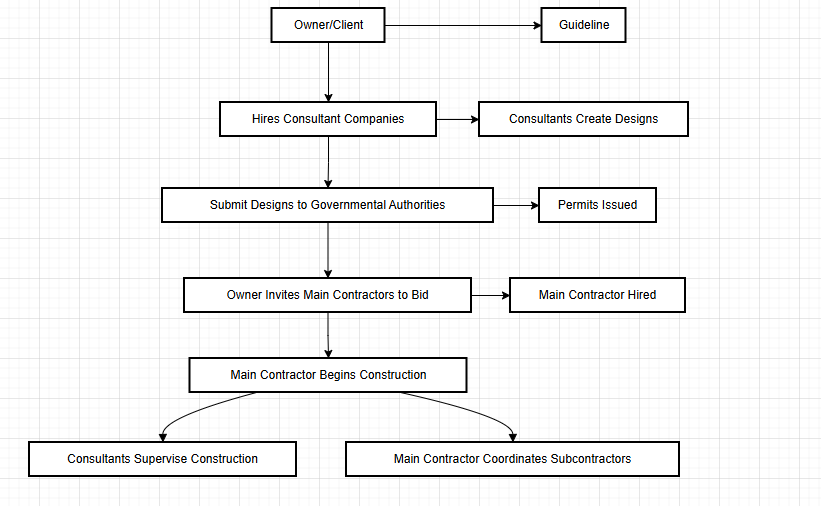

 Electrical Engineer