

Work in blocks
When you’re faced with a big project or job, it helps if you break it down into smaller, manageable parts. This prevents confusion and lack of clarity about the duties of employees in different organizational departments and also can saves time and money. By breaking down a larger project into smaller tasks, the work becomes more manageable and less intimidating. And they can be inspected in detail.
BPMN standard is a useful tool that provides a way to visually define and understand your organizational processes using professional business processes. It can identify functional boundaries and observe how new processes are performed.
In fact, BPMN diagrams are a simple concept, yet the BPMN modelling language allows for a large number of different graphical elements. A comprehensive number of symbols make diagrams more understandable, by depicting even the most complex business processes. From business analyst to stakeholders, it can be easily done. BPMN can display the weak and strong points of the processes in detail.
Sometimes the project that need to be reviewed has complex process diagrams. While it is true that BPMN supports modelling processes at various levels of detail, many users are accustomed to the “everything on one page” style, which hurts the overview and makes it difficult to understand and analyse the process. Psychologists have recognized that the best number of visual elements to focus on a chart is 3-7. In practice, this law is rarely followed.
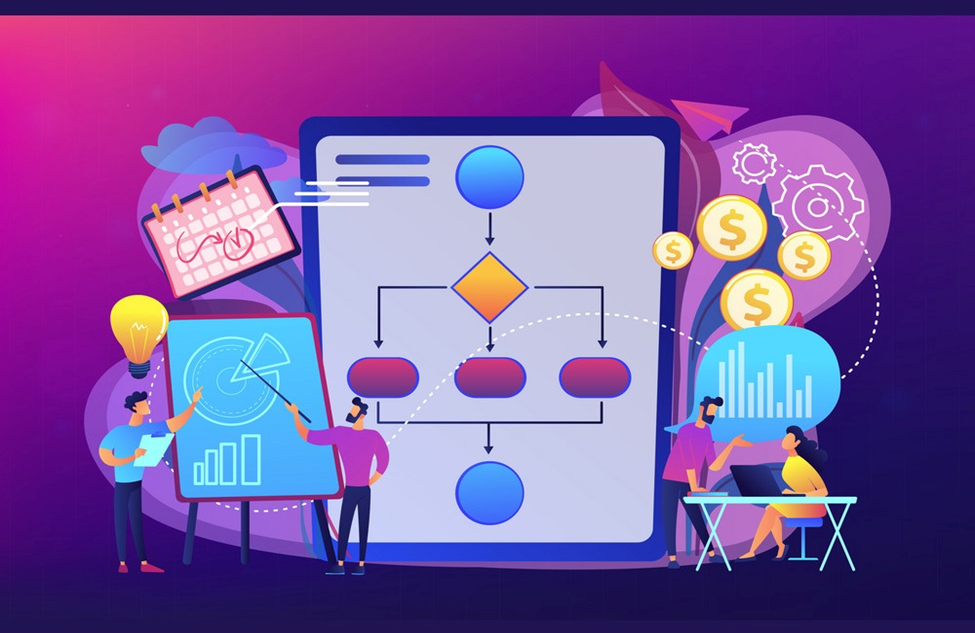
How to break large job and projects into small tasks in BPMN
Do you think you have a chance to draw a large BPMN workflow to model a complex problem? Obviously, drawing such a large diagram by hand is almost impossible. Even if you try to draw it with software, the whole diagram will be too small to put on the screen. Or if you want to zoom in on only a part of the diagram, it is not possible to show an overview of the workflow. In this article you will find the answer, it will show you how to break down your large BPMN structure into manageable parts.
The best method, which enables complex diagrams to solve problems and retain all important and essential information about business process tasks, is to use multiple layers of detail.
There are two kinds of constructs in BPMN that can help us manage oversized BPMN projects:
Sub-process approach:
- Some parts of your project process can be encapsulated in a number of subsystems and become a workflow.
- You can even convert a subsystem into multiple levels of decomposition (although this is not recommended in most cases).
Connect Intermediate Events:
Intermediate events must be linked in pairs. Linking is done between a target event and a source event with the same label.
Works in the business process are shown by activities, which includes: task and sub-process.
Tasks are atomic activities that cannot be further broken down. Therefore, to draw our complex works, we use the sub-process that can be broken down into another level of detail. It is worth knowing that choosing a task or sub-process depends on how much you need to know about the details of the work, as well as the complexity of the work.
Tasks are atomic activities that cannot be further broken down. Therefore, to draw our complex works, we use the sub-process that can be broken down into another level of detail. It is worth knowing that choosing a task or sub-process depends on how much you need to know about the details of the work, as well as the complexity of the work.
Find structure in your job
Regardless of what you do, finding a structure helps you to do your job most efficiently. one solution is creating or finding a structure for your job and structure contains a firm process, the process is a part of the structure. So no matter what your job is, productivity at work is important. By the structure you choose for your working day, you can increase the productivity of your job.
This structure and the process that are chosen can be different for each person, so having more information about different methods for structuring your job can be useful in finding a job structure and a firm process for it. In this article, we explain how to structure your job for maximum productivity.
What is the right way to structure you job?
There are many different ways to structure a job, and figuring out which of these processes is best for you can present challenges along the way. Before making a decision, you should have complete information about the different ways of structuring your job and check the different options.
Depending on what your job is, you may be limited in choosing your job structure. In this way, you can also use the BPMN which is a visual way to show how organizations work on services and structure of works, this process can be helpful in finding a job structure.
find the time of day when you are most productive
The first step to structuring your work is to find the time of day when you are most productive. This time of the day you can best focus on complex or large tasks and perform at your best in this field. This time can be different for different people and different tasks.
Set priorities for the next day
At the end of the work day, set priorities for the next day and determine what you are going to spend the next work day doing. In this case, instead of wasting time organizing your day, the next day you can start working immediately without any delay.
Work on the hard tasks first
The processes you consider to do the work are very important in the structure of your job, it is better to focus on more difficult and complex tasks first before working on less important projects. By doing this, you will do the most challenging part of your work sooner and it will be easier to focus on other tasks. If the end of the day is when you are most productive, work on the most difficult tasks first before moving on to other tasks.
Group similar tasks together
one solution to structuring your work is to group similar tasks. The reason this method is useful is that your day is less spent constantly moving between different activities. For example, if you have several different tasks related to data entry and research, you can spend an hour focusing on entering all the data, after completing this process, you can focus on all your research tasks.
Last word
Productivity is very important at work because it helps you to work effectively. To increase productivity, you must first find a suitable job structure and approve a strong process for this. There are many documentations in this field that the job structure affects the productivity of people and each person should adjust the job structure according to his conditions and job. Achieving this productivity gives you access to new opportunities.
Project Process
The project process is a vital issue in most small projects and although it can save you a lot of time and money. It’ll strengthen internal communication and assist in making much better decisions. Diagram visualizing and organizing techniques are beneficial here.
The working method is changing worldwide, and project-based work will make more progress soon. So, the demand for project processes is increasing. A great project process affects the business considerably. Tasks, timing, and budgets are not the only things we deal with in the project process.
A positive project process will bring effective results and more delighted employees. These results are not the side effects of the project process, but they are the primary components.
The Advantages of the Great Project Process
Everything will go smoothly in your business if the project process is done well. The teammates can focus on work, and there won’t be distractions.
These features will affect the bottom line of your business. A correct project process will lead your employees to work in line with your company’s strategies.
The project process will help you work on time and according to the budget. This process lets you map your project and know exactly what to expect. So you can efficiently use your resources and avoid any delays or other issues on the way.
The project process will reduce the complexity of internal communication and improve interactions. The process can increase transparency and accountability, even when individuals work across companies and teams.
The project process brings smarter data-driven decisions, and you will spot the bottlenecks much easier because you have mapped the project. You will get a deeper understanding of your priorities and decrease most risks.
The way we work is considerably different compared to past years. Project-based tasks are growing and gaining more attention. So, businesses must not ignore the power of the project process and the way that it affects the bottom line. Learning effective strategies to manage the projects successfully will change the results significantly.

 Electrical Engineer