
Competitive analysis, also referred to as competitor analysis, is a strategic process used by businesses to evaluate their competitors’ strengths, weaknesses, market positioning, and strategies. The goal is to gain insights that help improve a company’s own performance and competitive edge.
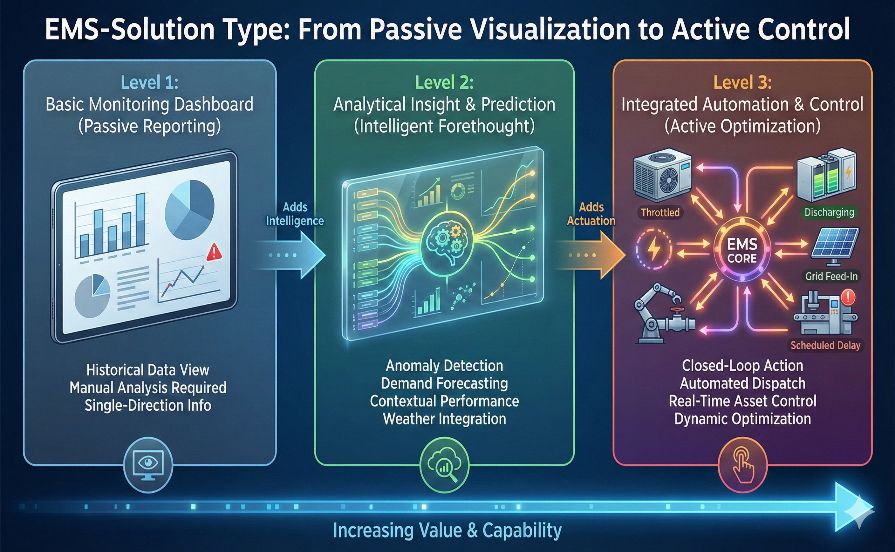
Focusing on Solution Types in Energy Management Solutions (EMS), we can categorize them based on the technology and approach they use. Here’s a breakdown of the key solution types in the EMS industry:
1. Smart Metering & Energy Monitoring Solutions
📌 Purpose: Real-time tracking of energy consumption for optimization.
📌 Key Technologies: IoT, cloud-based dashboards, AI-based anomaly detection.
📌 Companies: Schneider Electric, Siemens, Honeywell, Landis+Gyr.
📌 Users: Industrial plants, commercial buildings, utilities, and households.
2. Building Energy Management Systems (BEMS)
📌 Purpose: Automates HVAC, lighting, and energy control in buildings.
📌 Key Technologies: AI, IoT, digital twins for predictive energy optimization.
📌 Companies: Johnson Controls, ABB, Siemens, Honeywell.
📌 Users: Office buildings, hospitals, shopping malls, hotels.
3. Industrial Energy Management Systems (IEMS)
📌 Purpose: Energy optimization for manufacturing plants and heavy industries.
📌 Key Technologies: Predictive analytics, AI-driven process automation, carbon tracking.
📌 Companies: Rockwell Automation, GE Digital, Yokogawa, AVEVA.
📌 Users: Factories, refineries, large-scale industries.
4. Home Energy Management Systems (HEMS)
📌 Purpose: Smart home automation for energy-efficient appliances.
📌 Key Technologies: IoT, smart plugs, AI-driven energy scheduling.
📌 Companies: Nest (Google), Ecobee, Sense, Schneider Electric (Wiser).
📌 Users: Residential homeowners, smart home adopters.
5. Renewable Energy Management Solutions
📌 Purpose: Integration & optimization of solar, wind, and battery storage.
📌 Key Technologies: AI forecasting, energy storage management, grid balancing.
📌 Companies: Tesla Energy, Enphase, Sonnen, Fluence.
📌 Users: Solar farms, wind energy providers, microgrid operators.
6. Grid & Demand Response Management
📌 Purpose: Optimizing energy distribution, peak load balancing, reducing grid stress.
📌 Key Technologies: AI-powered predictive load management, blockchain-based energy trading.
📌 Companies: Enel X, GridPoint, AutoGrid, Oracle Energy.
📌 Users: Utilities, power companies, grid operators.
7. AI & Data Analytics for Energy Optimization
📌 Purpose: Uses AI to forecast demand, detect inefficiencies, and recommend cost-saving measures.
📌 Key Technologies: Machine learning, digital twins, energy simulations.
📌 Companies: C3.ai, SparkCognition, Uptake, Schneider Electric (EcoStruxure).
📌 Users: Large enterprises, government energy agencies, research firms.
8. Microgrid & Distributed Energy Management
📌 Purpose: Managing energy in localized grids, ensuring resilience & self-sufficiency.
📌 Key Technologies: AI-powered decentralized energy optimization, peer-to-peer energy trading.
📌 Companies: Siemens, Schneider Electric, LO3 Energy, PXiSE.
📌 Users: Remote communities, universities, corporate campuses, military bases.
9. Energy Trading & Blockchain Solutions
📌 Purpose: Decentralized peer-to-peer energy trading, reducing reliance on centralized grids.
📌 Key Technologies: Blockchain, smart contracts, distributed ledger technology.
📌 Companies: Power Ledger, LO3 Energy, WePower, Grid+.
📌 Users: Renewable energy producers, energy traders, decentralized grid networks.
10. Carbon & Sustainability Management Platforms
📌 Purpose: Tracks carbon footprint, reports ESG (Environmental, Social, Governance) compliance.
📌 Key Technologies: AI-driven sustainability dashboards, carbon credit tracking.
📌 Companies: IBM (Envizi), Persefoni, Salesforce Net Zero Cloud.
📌 Users: Enterprises, ESG-conscious organizations, government bodies.
Every Energy Management Solution field has a variety of players, including:
✅ Consulting Firms (for strategy & implementation)
✅ Software Companies (for AI, analytics, monitoring)
✅ Hardware & Equipment Providers (for smart meters, HVAC, sensors)
✅ Utilities & Energy Aggregators (for grid optimization & demand response)
✅ Startups & Innovators (for blockchain, AI-driven forecasting, microgrids)

 Electrical Engineer