
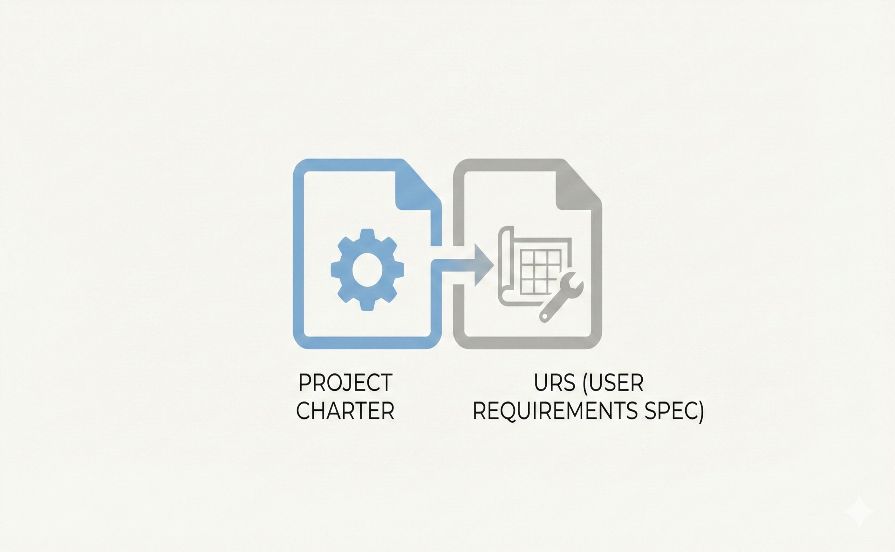
Effective project execution begins with total alignment between your stakeholders and your technical team. Far too often, projects derail because the high-level business vision doesn’t match engineering
reality, or vice versa. To bridge that gap and prevent costly miscommunications, I am sharing two foundational templates that keep everyone on the same page. Below, you’ll find the Project Charter, designed to lock in your business goals and resource allocation, alongside the User Requirements Specification (URS), which translates those exact business needs into a precise technical blueprint. Using both ensures your project is set up for success from day one.
THE BUSINESS CHARTER
Form 1: Project Charter
This form acts as a formal agreement that defines the project’s vision, boundaries, and resource allocation before detailed planning begins.
- Project Overview & Business Case
- Project Name: What is the official title or short name of this project? (e.g., SCADA Master Plan – Control Systems Upgrade Phase 2)
- Business Problem/Opportunity: What specific business challenge does this project solve, or what opportunity does it capture? (e.g., outdated components are no longer supported by manufacturers, or current systems lack real-time visibility leading to a 30% water loss)
- Project Vision: What is the desired future state once this system is implemented? (e.g., streamlined operations with remote control from anywhere, enabling predictive maintenance and zero environmental discharge violations
- Objectives & Success Criteria
- Measurable Objectives: What are the specific, measurable, achievable, relevant, and time-bound (SMART) goals for this project? (e.g., achieve a 99.99% system availability, or reduce energy consumption by 15% within 6 months)
- Success Criteria: How exactly will the business measure whether this project was a success at completion? (e.g., 100% of operators pass proficiency tests on the new HMI, or the project is completed within 5% of the approved budget baseline
- Scope & Deliverables
- In-Scope: What specific physical areas, systems, or features are included in this project? (e.g., replacement of all PLCs at Pump Station A, procurement of SCADA software licenses, and integration of existing field sensors)
- Out-of-Scope: What is explicitly excluded from this project to prevent scope creep? (e.g., civil engineering works, physical site security cameras, and upgrades to the corporate ERP software)
- Key Deliverables: What tangible products, services, or documents must be handed over upon completion? (e.g., Functional Design Specification (FDS), As-built CAD drawings, and Operations & Maintenance (O&M) manuals
- Financials & Timeline
- Estimated Budget: What is the approved high-level budget for this project, including hardware, software, and labor? (e.g., total budget of $1,000,000, including a 15% contingency for unforeseen technical hurdles)
- Timeline & Milestones: What are the critical deadlines and major checkpoints? (e.g., Factory Acceptance Testing (FAT) completed by Q3, and Final Go-Live/Site Acceptance Testing (SAT) sign-off by November 1st
- Stakeholders & Governance
- Key Stakeholders: Who is the Project Sponsor (final approver), the Project Manager, and who are the key end-users or subject matter experts? (e.g., Sponsor: VP of Operations; Project Manager: Lead Automation Engineer; End-Users: Plant Shift Supervisors)
- Roles & Responsibilities: Who has the authority to approve changes to the budget, scope, or timeline? (e.g., Project Manager tracks the budget and schedule; the Project Sponsor must formally approve any scope additions or budget increases
- Risks, Constraints, & Assumptions
- Known Risks: What are the high-level threats to this project’s success, and how will they be mitigated? (e.g., existing field devices may not support modern protocols; mitigated by budgeting for protocol gateways)
- Constraints: Are there any hard limitations? (e.g., all hardware must fit within existing NEMA 4X enclosures, or installation can only occur during the scheduled 48-hour winter plant shutdown)
- Assumptions: What factors are currently being considered as true for planning purposes? (e.g., assuming the existing facility fiber-optic network backbone has sufficient bandwidth, or internal IT staff will be available for server setup
Form 2: User Requirements Specification (URS)
(Engineering Focus) This form translates the customer’s operational needs into a technical blueprint that the engineering team will use for system design, testing, and validation.
- System Overview & Operational Environment
- System Function: What are the primary functions and capabilities the automation system must provide? (e.g., automated execution of batch recipes, real-time monitoring of chemical dosing, and automatic pump speed adjustment based on tank levels)
- Geographical/Physical Scope: Where will the equipment be located? Are there environmental factors to consider? (e.g., system spans 14 remote pump stations requiring cellular telemetry, or equipment will be in an explosive hazard area requiring intrinsically safe wiring
- Functional Requirements & Control Logic
- Control Modes: How will the system be operated? Define the requirements for Auto, Manual, Local, and Remote control modes. (e.g., Local-Manual via physical Hand-Off-Auto (HOA) switches, and Remote-Automatic where central SCADA software executes high-level optimization logic)
- Process Automation: Describe the specific operational sequences, automated responses, and interlocks required. (e.g., emergency shutdown protocols must initiate automatically on pressure deviation, or pump starts when wet well level reaches 80%)
- I/O (Input/Output) Point Estimates: Roughly how many Digital Inputs, Digital Outputs, Analog Inputs, and Analog Outputs are expected? (e.g., 140 Digital Inputs for valve status, 70 Digital Outputs for start/stop commands, 60 Analog Inputs for pressure/flow, and 20 Analog Outputs for VFD speed commands
- Human-Machine Interface (HMI) & Alarming
- HMI Design Requirements: How should the graphical interface be structured? (e.g., adherence to ISA-101 standards for situational awareness, requiring complex graphical displays to render in under 2.0 seconds, and 1-click navigation to trend displays)
- Alarm Management: What are the critical alarm conditions? How should alarms be prioritized, routed, and logged? (e.g., adherence to ISA-18.2 standards, dynamic alarm suppression during scheduled maintenance, and redundant visual coding using both color and shape)
- Data Management & Historian
- Performance Metrics: What are the required system response times and data refresh rates? (e.g., HMI data refresh rate of < 2 seconds for critical tags, and fast-moving regulatory control loop response within 1 second)
- Data Archiving & Reporting: What historical data must be logged, at what resolution, and for how long must it be retained? (e.g., 1-second timestamp accuracy for process variables, long-term archive retention for up to ten years, and automated generation of daily shift and alarm frequency reports
- System Interfaces & Integration
- External Systems: Does this control system need to communicate with other business systems? (e.g., integration with MES for production scheduling, CMMS to automatically trigger work orders for equipment wear, or ERP for chemical inventory management)
- Communication Protocols: What specific industrial protocols are required to talk to field devices? (e.g., Modbus TCP/IP for local PLCs, DNP3 for wide-area remote telemetry, and OPC UA for enterprise server data sharing
- Cybersecurity & Regulatory Compliance
- Cybersecurity Requirements: What level of security is required? (e.g., adherence to IEC 62443 guidelines, implementation of a Zone and Conduit architecture, Role-Based Access Control (RBAC), and Multi-Factor Authentication (MFA))
- Regulatory Standards: Does the system need to comply with specific industry regulations? (e.g., FDA 21 CFR Part 11 for electronic records and digital signatures, or specific municipal environmental agency reporting standards
- Testing, Training, & Documentation
- Acceptance Testing: What are the expectations for Factory Acceptance Testing (FAT) and Site Acceptance Testing (SAT)? (e.g., FAT must include simulation of server redundancy failures in a lab environment; SAT must include point-to-point loop checks on live instrumentation)
- Deliverables & Training: What specific documentation and operator training programs are required upon handover? (e.g., customized training simulator, 40 hours of hands-on operator training, and final As-Built wiring schematics

 Electrical Engineer