
Previously, I have published two articles on the safety of machinery and process safety. Building upon these topics, my upcoming post will explore the significance of ISO 31000, a globally recognized standard for risk management.
A certificate is not explicitly required for auditors under ISO 31000, a standard for risk management. The majority of organizations, however, prefer auditors who have relevant qualifications or certifications to demonstrate their competence in risk management and auditing. The presence of a certificate can enhance an auditor’s professional standing and enhance their ability to evaluate an organization’s risk management practices against ISO 31000.
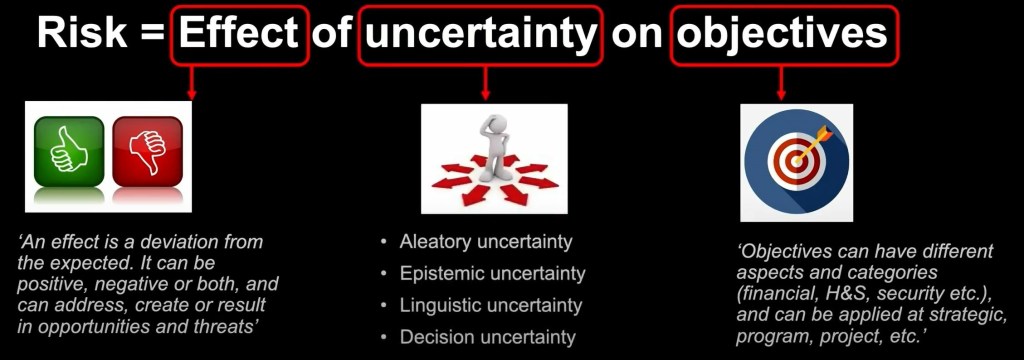
According to the ISO 31000 standard, risk can be defined as the “Effect of Uncertainty on Objectives.” This concise yet powerful statement encapsulates the core elements of risk management.
Objectives represent the desired goals or outcomes organizations strive to achieve, emphasizing the importance of clarity and alignment in defining objectives.
Uncertainty acknowledges the unpredictable nature of the business or industrial environment, encompassing various factors such as economic fluctuations, technological advancements, and regulatory changes.
Effect highlights the potential consequences or impacts of the interaction between uncertainty and objectives. By recognizing these key components, organizations can navigate risks effectively, make informed decisions, and safeguard their objectives in an ever-evolving landscape.
Example
Let’s dive into the objective of a site equipped with 20 freezers, specifically the Thermo Scientific™ TSX Series model. Such a site ensures the preservation and storage of sensitive materials, such as biological samples, pharmaceuticals, or research specimens, under optimal conditions. Thermo ScientificTM TSX Series freezers are renowned for their advanced temperature control and monitoring capabilities.
Objectives
The site’s objectives encompass several key aspects. Firstly, it involves maintaining the desired temperature range, typically set at ultra-low temperatures like -80 degrees Celsius, to prevent degradation or spoilage of stored items.
Additionally, the objective includes implementing a robust monitoring system to continuously track and record temperature fluctuations. This will enable prompt detection of deviations or anomalies.
Site managers want to ensure that site personnel are alerted as soon as possible in case of temperature excursions through integrated alarms and real-time data logging, allowing them to take immediate corrective action and mitigate risks.
Uncertainty
In the context of alarm systems and informing onsite staff about potential problems on a site with 20 freezers, there are two different scenarios to consider.
The first scenario involves utilizing the onboard remote alarm output feature of the freezers. This option allows for a direct and reliable means of raising alarms in case of issues. The uncertainty in this scenario lies in the possibility of technical glitches or failures that may affect the alarm system’s proper functioning. However, given that remote alarm output is a built-in feature of the TSX Series, it can generally be considered an effective method for promptly alerting onsite staff to potential problems.
Additionally, we need a text messaging system to inform the site manager who is not on site. The uncertainty lies in ensuring the correct person receives the alarm notification in a timely manner. The text message system can effectively communicate critical events with careful configuration, including accurate contact information and a clearly defined notification hierarchy.
Effect
The occurrence of a glitch in the freezer can have significant effects since we rely on it for various crucial functions. Freezers are the most reliable option as long as regular maintenance and audits are conducted correctly. However, a glitch can disrupt the freezer’s temperature control and stability, potentially compromising the integrity of stored materials. This risk can be mitigated by ensuring that qualified professionals handle maintenance tasks, such as regular inspections, calibration, and servicing. These tasks fall beyond our responsibility.
As discussed earlier, the second option of external energy monitoring for generating faults introduces a significant level of uncertainty. Additionally, this uncertainty could have a business impact. The responsibility for alarms and faults may be shared among multiple entities, such as the energy monitoring devices company, the company developing alarm business rules, or even the freezer itself. This distribution of responsibility can create complexity when identifying the root cause of an issue, potentially leading to delays in addressing critical faults.
The effect of a faulty text message system can have significant consequences on critical event notification. To mitigate this risk, one approach is to combine the text message system with an onsite beacon. By incorporating an onsite beacon, a visual and audible alarm can be triggered simultaneously with the text message notification. This dual approach enhances the alarm system’s reliability and effectiveness, providing an additional layer of redundancy.
Risk Assessment
Excel sheets can serve as valuable tools to systematically evaluate and document risks. The sheet should include essential columns such as Likelihood rating, Consequence rating, and Risk rating.
The likelihood rating column allows for the assessment of the probability or frequency of a risk event occurring. It helps quantify the chances of a risk materializing, whether it is low, medium, or high.
The Consequence rating column focuses on evaluating the potential impact or severity of the risk if it happens. This rating considers factors like financial loss, operational disruptions, safety hazards, or reputational damage.
The Risk rating column combines the Likelihood and Consequence ratings to provide an overall assessment of the risk level. This is usually on a scale of low, medium, or high.
Alarm Management
The concept of alarm management revolves around designing, implementing, and maintaining effective alarm systems within industrial and operational environments.
ISO 31000 provides a comprehensive framework for managing risks across various aspects of an organization. On the other hand, Alarm management focuses specifically on the effective design, implementation, and maintenance of alarm systems. This is to ensure timely and appropriate responses to abnormal or critical situations. The link between the two lies in identifying and mitigating alarm system risks. ISO 31000 emphasizes the need for organizations to assess risks systematically, including those related to safety and operational aspects such as alarms.
Type:
Type 1 Alarm System is designed to detect a physical threat, such as a fire or intrusion. Upon detection, it will trigger a visible and/or audible alert (i.e. an alarm). Type 2 Alarm System is designed to monitor a system, such as a freezer temperature. Upon detection of a parameter outside its normal range (i.e. too cold or too hot), it will trigger an alert to the user.
Type 1 and Type 2 Alarm Systems can both be addressable and non-addressable. Addressable systems can identify the exact location of a safety hazard or alarm event, such as the precise freezer that went out of the temperature range. Non-addressable systems can indicate an alarm event but may not be able to identify the exact location.
PME
The Schneider electric power monitoring expert or PME has an alarm user interface (UI) for its Alarms application.
- View types: There are two types of views, status views (existing alarm) and history views(View across the records).
- Classification is divided into three sections.
- Incidents: In terms of level, it is the highest. A list of alarm groupings and details is provided. Incidents required Acknowledgement to change the type from Status to History.
- Alarms: In terms of level, it is the middle level. Timing and conditions are taken into account when programming alarms. In addition, alarms and incidents are mapped. Alarms can mostly change the view type automatically.
- Events: In terms of level, it is the lowest level. An event is a record of an activity or condition that is logged in PME.

 Electrical Engineer