

EMS Energy Management System (EMS) is a computerized system or framework used to manage and monitor the energy consumption of a building, industrial plant, data centre, or other energy-consuming installations. It monitors energy consumption and provides information to help facility managers decide about energy use. The system typically consists of software, hardware, and a communications network to enable remote access and energy consumption monitoring. It is used to improve the efficiency of an energy system and reduce its environmental impact.
Building classifications
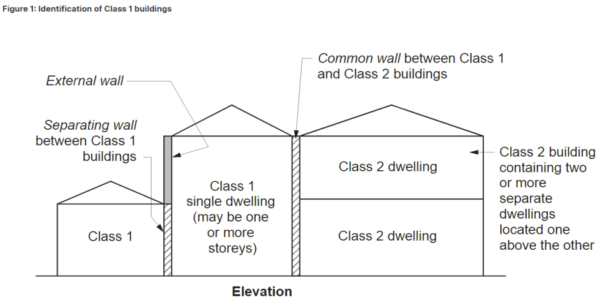
All building work must comply with the requirements of the Building Code of Australia (BCA).
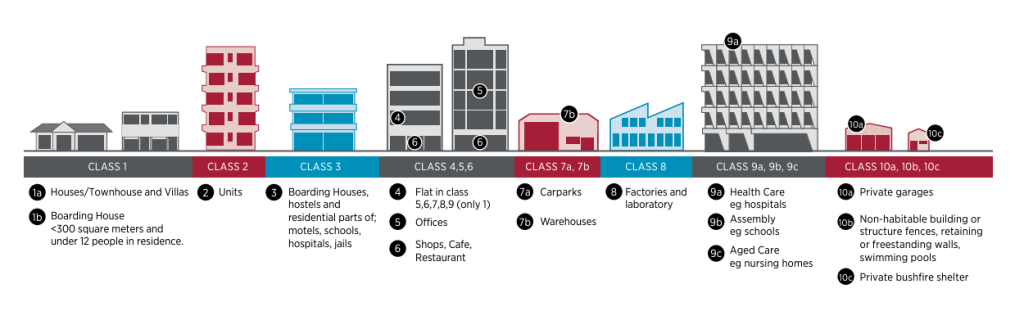
According to DCA there are 10 class of buildings
Australian Building Codes Board (ABCB) is a standard writing body responsible for the National Construction Code (NCC) and Part J8 is about Facilities for energy monitoring.
J8.3 Facilities for energy monitoring Guide
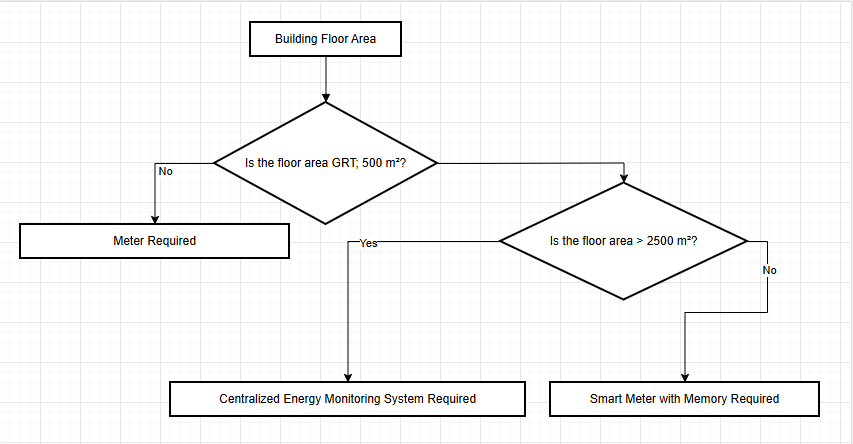
- (a) A building or sole-occupancy unit with a floor area of more than 500 m2 must have an energy meter configured to record the time-of-use consumption of gas and electricity.
<<In simple terms, this means a smart meter with memory>> - (b) A building with a floor area of more than 2 500 m2 must have energy meters configured to enable individual time-of-use energy consumption data recording, in accordance with
- (c), of the energy consumption of—
- (I) air-conditioning plant including, where appropriate, heating plant, cooling plant and air handling fans; and
- (ii) artificial lighting; and
- (iii) appliance power; and
- (iv) central hot water supply; and
- (v) internal transport devices, including lifts, escalators and moving walkways where there is more than one serving the building; and
- (vi) other ancillary plant.
- (c) Energy meters required by (b) must be interlinked by a communication system that collates the time-of-use energy consumption data to a single interface monitoring system where it can be stored, analysed and reviewed.
- (d) The provisions of (b) do not apply to a Class 2 building with a floor area of more than 2 500 m2 where the total area of the common areas is less than 500 m2.
<<A Software is required to collect and store energy data for different sections. The law does not apply to residential apartments.>>
| Section | Title | Key Points Regarding Electricity |
|---|---|---|
| J8D2 | Heated Water Supply | No specific provisions for electricity meters. |
| J8D3 | Swimming Pool Heating and Pumping | Requires time switches for electric pool heaters and pumps to control electricity use. |
| J8D4 | Spa Pool Heating and Pumping | Similar to swimming pools, time switches and push buttons are required for systems using electric heaters or pumps. |
| J9D3 | Facilities for Energy Monitoring | – Buildings >500 m²: Must have meters to track time-of-use electricity consumption. – Buildings >2,500 m²: Additional metering for specific systems like air-conditioning, lighting, electric vehicle charging, etc. |
| J9D4 | Facilities for Electric Vehicle Charging | Requires dedicated electrical distribution boards with electricity metering for electric vehicle charging points. |
| J9D5 | Facilities for Solar Photovoltaic and Battery Systems | Provisions to monitor electricity generated from solar panels and stored in batteries. |
In J9D3, additional systems, such as on-site renewable energy equipment, electric vehicle charging equipment, and battery systems, are included in the list of systems for which energy data must be recorded. J8.3 does not explicitly mention these systems.
An Automatic Monitoring System (AMS) is an energy management system that provides automatic, real-time monitoring and control of energy consumption. Automated monitoring systems can detect energy usage patterns and alert when certain thresholds are met. They can provide more accurate billing, demand management, and energy efficiency opportunities. An AMS is typically used in large commercial and industrial facilities like data centres, manufacturing plants, and office buildings.
EMS is not for billing.
The National Construction Code (NCC) is a code of practice that sets out the minimum requirements for the design, construction and performance of all new buildings in Australia, including safety, health, amenity and sustainability objectives. It is produced and maintained by the Australian Building Codes Board (ABCB) with the help of government and industry representatives. The NCC contains the Building Code of Australia (BCA) and other documents that detail the technical requirements for building work in Australia. The NCC is updated on a three-year cycle, with each edition of the Code covering all buildings in Australia, for all climate zones.
Section J8 of the National Construction Code (NCC) is a tool for the energy assessment of a building or dwelling before and during its construction. It is based on the NCC Volume One, Building Code of Australia (BCA) and provides a single, comprehensive approach to assessing energy performance for all types of buildings and dwellings. Section J8 sets out methods and procedures for assessing the total energy performance of a building, including its efficiency, energy efficiency and other environmental considerations.
Energy Efficiency Legislation
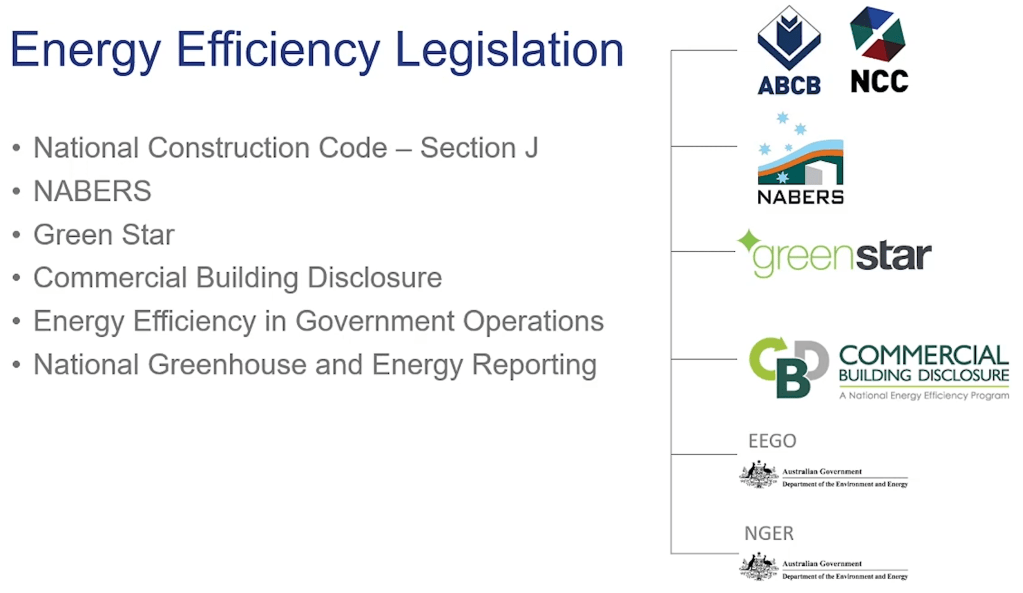
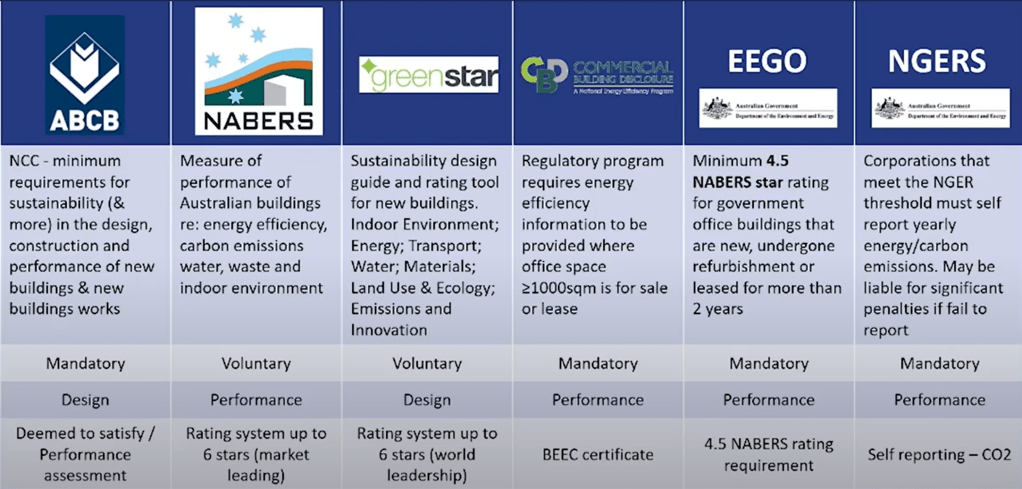
Six codes deal with energy efficiency in Australia, and the National Construction Code is the most important. NABERS and Greenstar are voluntary initiatives that can be part of compulsory energy efficiency requirements.
In a nutshell, Part C of Section J8 Three requires energy meters to measure the key loads of a building and to connect to a single user interface for data collection. The data must be time and date stamped and easily identifiable.
NABERS National Australian Built Environment Rating System
It is a voluntary rating tool, except when used for the Commercial Building Disclosure Program. To get a NABERS rating, you must engage an accredited assessor, and the rating is based on twelve months of operational data. The more efficient the building, the higher the rating.
NABERS ratings help building owners understand their performance versus similar buildings. It gives them a competitive advantage over prospective buyers, renters, procurement teams, or hotel guests.
NABERS is a 6 * STAR* rating system.
An electricity metering and monitoring document is available from NSW Climate and Energy Action, which NABERS cited in this report. NABERS details are available in two separate posts.
NABERS is a performance rating tool for operational buildings
Green Star
Green Star is an internationally recognized national voluntary environmental rating system that evaluates buildings and communities’ environmental design and construction. Green Star-certified buildings produce 56% fewer greenhouse gas emissions than average Australian buildings and use 66% less electricity than the average Australian building. Pathway to become Green Star Accredited Professional (GSAP)
- Review the specific Green Star rating tools for the type of project:
- Green Star – Design & As Built (for new buildings or major refurbishments)
- Green Star – Interiors (for fit-outs)
- Green Star – Communities (for larger developments)
- Green Star – Performance (for operational buildings)
- Ratings are awarded on a star-based scale:
- 4 Star: Best Practice
- 5 Star: Australian Excellence
- 6 Star: World Leadership
- Develop and Document the Design (support claims for each credit)
- Energy models
- Material sourcing certifications
- Waste management plans
- Indoor air quality assessments
- More on Energy Model
- The energy model should align with the National Construction Code (NCC) Section J
- The model must account for all energy-consuming systems, including HVAC, lighting, domestic hot water, and other significant equipment.
- Energy simulations should be conducted using software accredited by the GBCA
- Provide thorough documentation of all inputs and assumptions used in the energy model, including: e.g Building geometry, Material properties, insulations , HVAC specifications, internal loads etc
BASIX
BASIX stands for Building Sustainability Index. It is a sustainability assessment tool for residential buildings in NSW. Basex focuses on new homes by requiring them to meet certain minimum standards (for water and energy efficiency, and thermal performance) and to report construction materials so that embodied energy can be calculated.
BASIX is a compliance tool for new residential construction. BASIX is mostly about the design and product selections
CBD Commercial Building Disclosure
The Commercial Building Disclosure Scheme is a national program that aims to improve the energy efficiency of large office buildings in Australia. It is managed by the Australian Government Department of Industry, Science, Energy and Resources.
The commercial building disclosure scheme or CBD Scheme is a national program that aims to improve the energy efficiency of large office buildings in Australia. It is managed by the Australian Government Department of Industry, Science, Energy and Resources. The CBD scheme requires most sellers or leases of office space of a thousand square meters and above to obtain and disclose a valid building energy efficiency certificate or have a 12-month validity period. The commercial building disclosure scheme is probably why the NABERS certification is applied in Australia.
EEGO Energy Efficiency in Government Operations
The federal government has set a minimum energy performance standard for its buildings. If applicable, whole buildings must have 4.5 NABERS Energy stars or only NABERS Energy-based buildings. Government agencies and departments receiving substantial budgets must implement energy efficiency measures. The federal government has set a minimum energy performance standard for its buildings based on NABERS ratings. This means that the required NABERS energy rating for the whole building is 4.5 stars. Green Lease Schedule or GLS is required for lease building.
NGERS National Greenhouse and Energy Reporting Scheme
The National Greenhouse and Energy Reporting Scheme was introduced in 2007 to provide data and accounting about greenhouse gas emissions, energy consumption, and production. It is used with other schemes such as NABERS. This scheme is purely based on co2 emissions, but to reduce these co2 emissions. Of course, it needs to look at energy efficiency.
National Construction Code (NCC)
ABCB [Australian Building code board] created and maintains the National Construction Code (NCC). It is the Minimum set of standards for all buildings to meet. It is enforced by local and state government BCA Volume 1, Section J8.3 – Facilities for Energy Monitoring. Local and state governments enforce this code
The NCC consists of two parts, the building code of Australia and the plumbing code of Australia. The building code consists of two volumes: 1) multi-family residential, commercial, industrial, and public buildings. 2) low-rise residential and non-habitable buildings
Energy monitoring (Part J8.3)
A building or sole-occupancy unit with a floor area of more than 500m2 must have the facility to record gas and electricity consumption. A building with a floor area of more than 2,500m2 must have energy meters configured to enable individual time-of-use energy consumption data recording, in accordance with (c), of the energy consumption of-
- air-conditioning plant, including, where appropriate, heating plant, cooling plant and air handling fans; and
- appliance power; and
- artificial lighting; and
- Central hot water supply; and
- Internal transport devices, including lifts, escalators and travelators where there is more than one serving the building; and
- other ancillary plant
Energy meters required by (b) must be interlinked by a communication system that collates the time-of-use energy consumption data to a single interface monitoring system where it can be stored, analyzed and reviewed.
The provisions of (b) do not apply to a Class 2 building with a floor area of more than 2500m2 where the total area of the common areas is less than 500m2.
ON MARKET
“On market” refers to meters that are part of the main electricity supply network. In an apartment building, the “on market” meter is the main authority meter connected to the supply network. The other meters in the building might form an embedded network. Alternatively, all meters can be “on market,” connecting separately to an Advanced Metering Infrastructure (AMI) and controlled by separate or the same retailers. These meters must meet specific requirements, including form factor standards (EDMI shape), and cannot be din rail meters.
USA Local Low
Local Law97: Sets strict carbon emission limits for buildings over 25,000 square feet across New York City.
Estimated that 50000 buildings are affected.
Fine: 268$ per tone over the allowed threshold.
Local Law 95: Building Energy Efficiency Score Law. Building Owners are required to post a grade for their energy performance.
Note that energy efficiency and carbon emission are not the same. (Carbon emission related to what fuel are using)
Local Law 87: Energy Audit – Requires building owners to perform, at the minimum, an Level II Energy audit ASHRAE (American Society of Heating, Refrigerating and Air-Conditioning Engineers) and Retro-commissioning on the base building systems.
Must be performed within four years of required reporting date
Energy Efficiency Report due every ten years
Audit Levels
There are three levels of audits:
ASHRAE Level I – Walk-Through Analysis High level, no cost analysis
ASHRAE Level II – Energy Survey and Analysis – Breakdown of energy sources and end
ASHRAE Level III – Detailed Analysis of Capital-Intensive Modifications-
Local Law 84: Energy Benchmarking. Energy benchmarking is measuring a building’s energy consumption and comparing it to past performance, similar buildings, or established standards.
Standard Boards
AASB: The Australian Accounting Standards Board (AASB) is an independent, non-corporate Commonwealth entity of the Australian Government that develops, issues and maintains accounting standards applicable to entities in the private and public sectors of the Australian economy.
AUASB: The Auditing and Assurance Standards Board (AUASB) is an independent, non-corporate Commonwealth entity of the Australian Government, responsible for developing, issuing and maintaining auditing and assurance standards.
IFRS: The International Financial Reporting Standards (IFRS) Foundation is a not-for-profit established to develop globally accepted accounting and sustainability disclosure standards.
The Standards are developed by their two standard-setting boards, the International Accounting Standards Board (IASB) and the International Sustainability Standards Board’s (ISSB).
ISSB: The International Sustainability Standards Board (ISSB) was established in 2021 to develop a comprehensive global baseline of sustainability disclosures for capital markets.
NGER Reporting Entity: An entity required to lodge financial reports under Chapter 2M of the Corporations Act (2001) (Cth) that is registered as a ‘Controlling Corporation’ reporting under the National Greenhouse and Energy Reporting Act 2007 (Cth).
TCFD: The Task Force on Climate-Related Financial Disclosures (TCFD) was created by the Financial Stability Board (FSB). In 2017, the TCFD released climate-related financial disclosure recommendations.
Carbon Emission
Scope 1, 2, and 3 (emissions): Scope 1 covers direct greenhouse gas emissions from owned or controlled sources. Scope 2 covers indirect greenhouse gas emissions from the generation of purchased electricity, steam, heating and cooling consumed by the reporting company.
Scope 3 includes all other greenhouse gas emissions that occur upstream and downstream in a company’s value chain.
Paris Agreement: The Paris Agreement refers to the international treaty on climate change, of which Australia is a party, which came into force in 2016. The Paris Agreement aims to strengthen global responses to climate change.
Emissions Metrics:
It outlines how organizations should report their greenhouse gas emissions. This involves categorizing emissions into scopes (Scope 1, 2, and 3), each representing different emissions related to the organization’s operations.
Scope 1 emissions come from sources a company owns or controls, including vehicles, furnaces, boilers, and any other direct emissions from company-owned and operated resources. Scope 1 emissions are those generated by a company’s facilities.
Scope 2 emissions are indirect electricity, steam, heat, and cooling. The company’s facilities do not produce these emissions. Purchasing electricity from a power utility to power a building or facility is a Scope 2 emission. Electricity suppliers directly emit these emissions (Scope 1).
Scope 3: Indirect emissions in a company’s value chain are included in Scope 3. They can be classified as ‘upstream’ emissions (relative to purchases or acquisitions) and ‘downstream’ emissions (relative to sales). Scope 3 emissions include material purchases, transportation, business travel, employee commuting, and the use of sold products.
Calculation
Emissions are calculated using the amount of energy purchased/produced (in kWh for electricity, for example) and emission factors representing the average emissions intensity.
Emission factors can be 1) Activity-Based or 2) Spend-Based (These are often used for Scope 3 emissions, where direct activity data might be hard to obtain).
A carbon dioxide emission factor estimates emissions associated with a specific activity. For example, how much electricity does a natural gas power plant generate? (Or a store used for lighting)
Using spend-based emission factors, you can calculate emissions related to monetary expenditures, like transportation costs or purchases.
U.S. Environmental Protection Agency (EPA): The EPA provides emission factors through its GHG Emissions Hub.
UK Government’s Department for Environment, Food & Rural Affairs (DEFRA): DEFRA publishes an annual set of emission factors.
Intergovernmental Panel on Climate Change (IPCC): The IPCC’s Emission Factor Database (EFDB) offers a range of emission factors.
Ecoinvent: This life cycle assessment database provides detailed emission factors focusing on their entire life cycle.
Sphera: Offers comprehensive Managed LCA Content with over 15,000 annually updated datasets that include process-based emission factors.
Safety Standard
It is required and mandatory to follow most safety standards
IEC 62052-31:2015: specifies product safety requirements for electrical energy measurement and control equipment. This standard applies to new metering equipment manufactured to measure and control electrical energy over networks with frequencies of 50 Hz or 60 Hz and voltages up to 600 volts. All functional elements of the equipment, including any add-on modules, must be enclosed in or formed in one case to ensure safety and reliability.
Not Safety Standards
AS 4755: Deals with demand response capabilities for electrical products. Incorporating these capabilities could enhance the EMS’s effectiveness in managing energy during peak and off-peak periods. AEMO / National Level
National Australian Built Environment Rating System (NABERS): This system measures environmental performance of commercial buildings and could be adapted to assess the performance of convenience stores. Integrating NABERS criteria into your EMS could provide a competitive edge. Nothing for Small shops
Green Star: A voluntary sustainability rating system for buildings in Australia, which assesses the environmental design and construction aspects of buildings.
Australian Energy Regulator (AER): Ensures energy markets operate in accordance with the national legislation and rules. Compliance with AER requirements is essential.
ISO 50001
In summary, ISO 50001 is a voluntary standard that provides a structured approach to energy management. It is fundamentally a management standard but often supported by software tools that facilitate energy performance monitoring, measurement, and improvement.
ISO 50001 is an international standard for energy management systems (EnMS) that provides organizations with a framework to improve energy performance, including efficiency, use, and consumption. ISO 50001 helps organizations establish the systems and processes necessary to improve energy performance, reduce energy costs, and lower greenhouse gas emissions.
ISO 50001 is not compulsory. Organizations can choose to adopt it voluntarily. ISO 50001 nevertheless demonstrates an organization’s commitment to energy efficiency.
The ISO 50001 standard focuses on management practices and processes that organizations can put in place to improve energy efficiency. Energy management software can help organizations monitor and analyze energy use.
Steps to Implementing ISO 50001
- Obtain Management Commitment
- Ensure top management is committed to implementing an energy management system (EnMS) and providing necessary resources.
- Establish an Energy Team
- Form a team responsible for developing, implementing, and maintaining the EnMS.
- Conduct an Energy Review
- Analyze current energy use and consumption to identify significant energy uses and opportunities for improvement.
- Define the Scope and Boundaries
- Determine the scope and boundaries of the EnMS, specifying the parts of the organization and activities included.
- Develop an Energy Policy
- Create a policy that outlines the organization’s commitment to energy performance improvement.
- Set Objectives and Targets
- Establish measurable energy objectives and targets based on the energy review and policy.
- Develop an Energy Baseline
- Establish a baseline of energy performance to measure improvements against.
- Identify Energy Performance Indicators (EnPIs)
- Determine appropriate EnPIs to track energy performance and progress towards targets.
- Implement Action Plans
- Develop and implement action plans to achieve the objectives and targets.
- Provide Training and Awareness
- Ensure employees are trained and aware of the EnMS and their roles in improving energy performance.
- Document the EnMS
- Document the processes, procedures, and records required by ISO 50001.
- Monitor and Measure Energy Performance
- Regularly monitor and measure energy performance against the EnPIs, objectives, and targets.
- Conduct Internal Audits
- Perform internal audits to ensure the EnMS is effectively implemented and maintained.
- Review and Improve the EnMS
- Conduct management reviews to assess the EnMS and identify opportunities for improvement.
- Achieve Certification (Optional)
- If desired, undergo an external audit by a certification body to achieve ISO 50001 certification.
| Standard | Short Explanation | Compulsory Situation |
|---|---|---|
| NCC J9 | Energy monitoring and on-site distributed energy resources requirements in the National Construction Code | Compulsory for buildings with a floor area of more than 500 m² to have energy meters for time-of-use consumption monitoring |
| NatHERS | Nationwide House Energy Rating Scheme that provides energy ratings for new dwellings based on their thermal performance | Compulsory for new residential buildings or major renovations to comply with the National Construction Code energy efficiency standards |
| NCC J8.3 | Specific clause in the National Construction Code related to energy efficiency requirements | Compulsory as part of the overall NCC compliance for applicable building classes |
| BASIX | Building Sustainability Index, a comprehensive sustainability assessment tool specific to New South Wales | Compulsory for new residential developments and significant renovations in New South Wales |
| NABERS | National Australian Built Environment Rating System that measures the operational performance of existing buildings | Compulsory for certain commercial buildings in Australia, with annual reviews to maintain up-to-date ratings |

 Electrical Engineer