
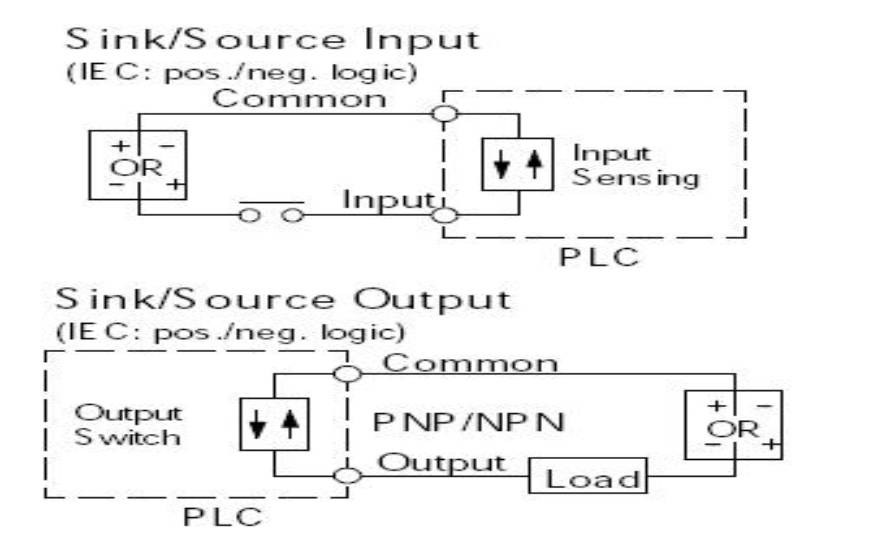
As industrial automation engineers, we need to understand the concept of sourcing and thinking. This is required to appropriately select the sensors, actuators as well as PLC IO cards.
Let’s start with a simple example, a switch and a lamp. When the switch is closed, the current flows to the circuit and the lamp, in this example the current first enters the switch and then the lamp so the switch is sourcing type.

Now, let us modify the subject a bit, let us first connect the lamp to the power source and then connect the switch. However, nothing has changed but the switch is the sinking type and the current sinks in the switch.

The same terminology is used to denote the sinking or those types of input or output modules of ability or a controller. If one has understood the circuit diagrams explained, it would be clear that if the sensor is a sinking type, then the module would be a sourcing type. When the sensor gives a true condition, it acts as a closed switch and in false condition, It acts as an open switch.
The input module is a sinking type, all sensors will be connected to a positive point on the module and the output of different sensors will be connected to the individual points on the input module when a sensor is triggered, that first flows into the sensor then into the input module, hence the input module as a sinking date. The same analogy can be used for a type input module.

Then using a sourcing type input module, care should be taken to connect the common of all the sensors to the ground of the module. Understanding this concept of sourcing and thinking will help us to select the sensors and actuators
| Actuator: COMMON + | SOURCE | PNP |
| Actuator: COMMON GND | SINK | NPN |
SENSOR: NPN CONNECT 24V TO COMMON OF INPUT CARD (Source)
SENSOR: PNP CONNECT 0V TO COMMON of Input Card (Sink)
Note that MOST INPUT CARDs DOES NOT HAVE PNP OR NPN IT WORK FOR BOTH

Digital Output Types
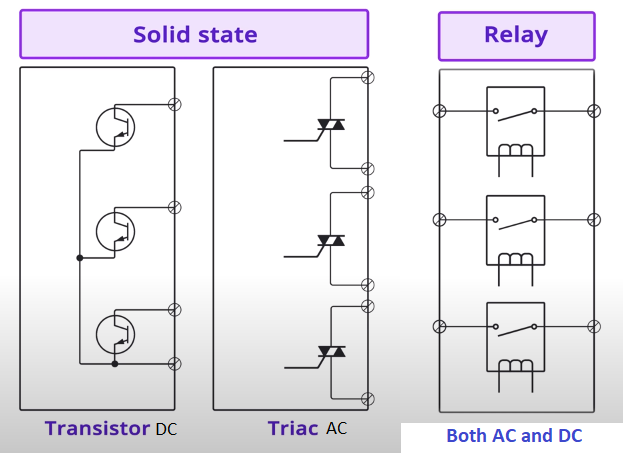
There are two types of Plc digital output modules, solid-state and relay. When PLCs were first introduced, the only outputs were relay type, with a separate relay dedicated to each output. As with any typical relay, the Plc output module had physical coils and relay contacts contained inside. The contacts were operated by applying a voltage to the relay coil. The contacts were connected to an external supply to turn on or off a discrete device. Relay outputs can operate both AC and DC load, as relay contacts are voltage-independent. That’s one advantage of relay type. As solid-state type output modules are not voltage-independent. Relay output modules are available with single-pole, double-throw, or SPDT (Single Pole Double Throw) outputs.
Solid-state output modules are often referred to as switching modules. Output devices are turned on or off by using solid-state devices such as a bipolar junction transistor or BJT or a TRIAC. As we said earlier, the transistor output module is voltage-dependent and can only operate DC loads. Unlike a relay output module that is happy to operate AC or DC loads, it’s important that the load power supply is connected with the correct polarity, as the module can be either syncing type or sourcing type.
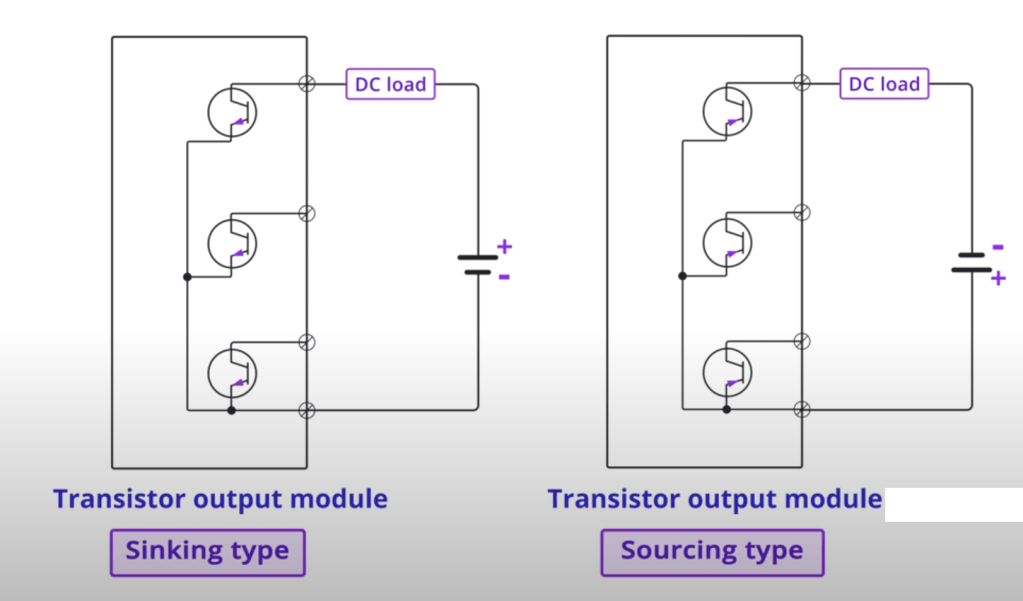
A TRIAC output module is capable of controlling AC loads whereas transistor output modules can control DC loads only.
Relays generally have a higher current rating than transistors, but as with any mechanical device, it will wear out with time. A relay module can operate AC or DC loads or both. Relays provide electrical isolation between the load and the Plc. Relays are slow-acting, with typical response times of ten milliseconds or greater. Closed relay contacts are almost zero Ohms, thus ensuring no voltage loss. Transistor output modules are for DC applications only. Transistors typically cannot switch a large load current, as can a relay. A transistor is fast because there are no mechanical parts. The response time is much faster than relays because a transistor is not a perfect switch, there’s always a small voltage drop across it when turned on. In some transistor modules, there is a leakage current even when turned off. A TRIAC output is used to control AC loads only. As with the transistor, a TRIAC is much faster than a relay. Triage outputs are suited to low power AC loads such as lighting, motor starters, and contractors with current ratings around one amp.

 Electrical Engineer