
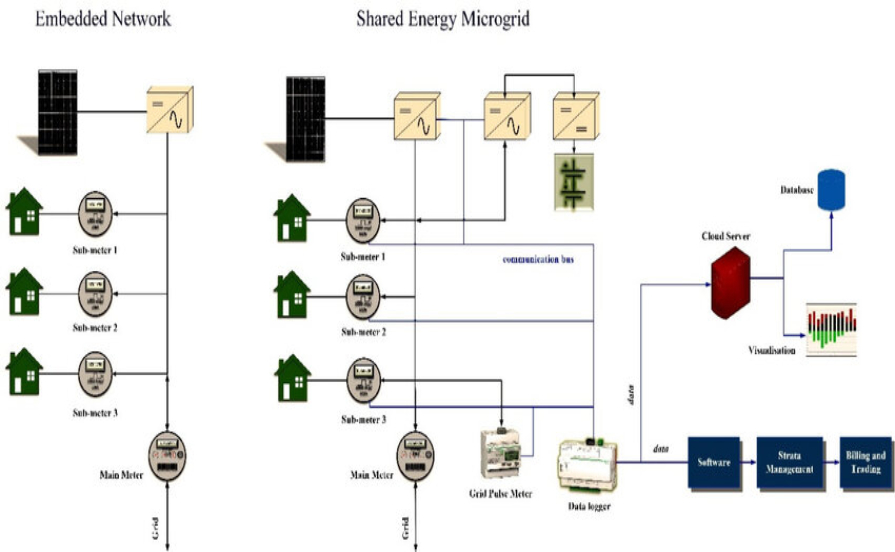
Embedded Network
According to AER, (Australian Energy Regulator), In some sites (typically apartment blocks, retirement villages, caravan parks and shopping centres), the electrical wiring is configured in such a way as to enable the owner of the site to sell energy to all the tenants or residents based there. This is known as an embedded network. The site owner with an embedded network usually buys energy from an energy retailer and then ‘onsells’ the energy to the different consumers at the site.
In some situations, the energy the owner sells may be generated on-site. Most people selling energy in embedded networks are exempt sellers because they do not need to become authorised by the AER as energy retailers. However, they need to hold a valid exemption from the AER and follow specific rules. These rules are there to protect your rights.
If you are in an embedded network, you can buy electricity from an authorised energy retailer or an exempt seller. However, consumers in an embedded network may have difficulty buying energy from a seller other than the exempt seller. This is because of how the network has been wired or because energy retailers may not want to sell to a consumer inside an embedded network. If you can choose and buy from an energy retailer instead of the site’s exempt seller, you must be careful not to pay twice for network charges.
Australian buildings can receive Green Star Ratings, certified by the Green Building Council of Australia (GBCA).
What is an Embedded Network:
The embedded network is explained in a post I wrote about billing. Due to the importance of this subject, I have created a post for it.
Embedded networks are private electricity networks that serve multiple premises, such as apartment blocks, caravan parks and shopping centres. The owner of the site with an embedded network runs the network infrastructure.
An embedded network is a distribution system connected at a parent connection point to either a distribution system or transmission system that forms part of the national grid. It is owned, controlled or operated by a person who is not a network service provider. As a result, its mini network is still connected to the grid at a parent connection point or a gate meter (Authority Parent Meter). I guess the key part of that definition is that it’s operated by someone other than a network service provider. An NSP is essentially a distribution system.
DETAILED MARKET DESIGN
AEMO
Each tenant in the embedded network also has their own energy meter. Also, they may have private energy sources which are negative demand. This may be energy from the grid, solar panels, or even batteries. Within the network, the parent will purchase a wider grid electricity supply and distribute it to each individual child.
Based on the AEMO guideline The metwing equipment for On-Market Child must be National Metering Institute Pattern Approved.
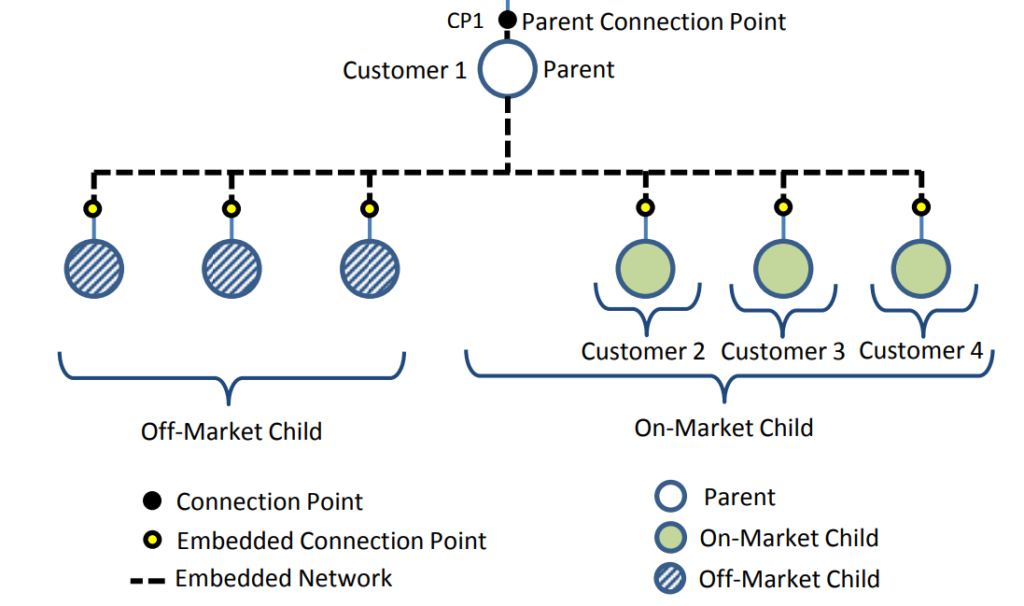
The parent connection point has a physical connection to the distribution network. The embedded
network takes supply from the parent connection point, and child connection points are connected
after this point. Child connection points within the embedded network have a physical connection
to the embedded network and take supply from the embedded network. Customers at these child
connections can be at off-market child connection points, supplied by the embedded network
operator, or at on-market child connection points, purchasing from a retailer.3
The terminology
Exempt selling occurs when a person or business purchases energy from a retailer and on-sells the energy to their customers, commonly through an embedded network.
Network exemption: An exempt network holder is a person or company with permission from the relevant electricity authority to use and operate their own private electricity network.
Under the National Electricity Rules (NER), any party that engages in an electricity transmission or distribution activity must either be registered with the Australian Energy Market Operator (AEMO) as a network service provider (NSP) or gain an exemption from the requirement to be a registered NSP from the AER.
Australian Energy Market Commission (AEMC)
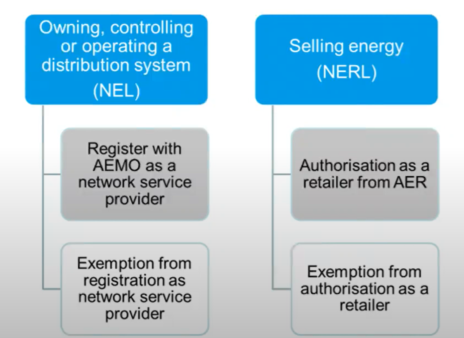
For Owning, controlling or operating a distribution system (NEL)/(NERL) essentially there are two tiers of regulation you’re either authorized or registered, or you’re exempt from those requirements.
Future Rule
Link
Embedded Network Operator vs Embedded Network Manager
There is a significant difference between an Embedded Network Manager (ENM) and an Embedded Network Operator (ENO).
Although the terms are often confused, they refer to two distinct roles with different responsibilities. In simple terms, the Operator manages the internal day-to-day billing and customer service, while the Manager is a technical, market-facing role that allows customers to access other retailers.
A company can be both an Operator and a Manager, but the functions are separate.
. Embedded Network Operator (ENO)
This is a traditional, customer-facing role. The ENO is the entity responsible for the private network’s day-to-day running. This is the company you deal with as a resident.
Key Responsibilities:
- Billing and Collections: Issue electricity (or water/gas) bills to “off-market” residents within the building and collect payments.
- Customer Service: Handling moving in/out, account setup, and general inquiries.
- On-selling Energy: Buying electricity in bulk from the grid and selling it to individual tenants.
- Infrastructure: In some cases, operating and maintaining the physical network infrastructure (wires and meters) within the building.
The Australian Energy Regulator (AER) often uses the term Exempt Embedded Network Service Provider (EENSP) to describe this role.
Embedded Network Manager (ENM)
This is a new, highly technical role created to facilitate retail competition and consumer choice (known as the “Power of Choice”). An ENM must be formally accredited by the Australian Energy Market Operator (AEMO).
Key Responsibilities:
- Enabling Retail Choice: The ENM’s primary purpose is to allow a customer to switch away from the building’s operator (the ENO) and choose their own “on-market” retailer (like AGL, Origin, etc.).
- Market Interface: The ENM performs “market interface functions”. When you switch, the ENM does:
- Create a unique National Metering Identifier (NMI) for your apartment.
- Register your meter in the national energy market system (called MSATS).
- Maintaining Data: The ENM manages the metering data in the national system, making your meter “visible” to all other retailers so they can make you an offer.
The ENM is not involved in the day-to-day billing or customer service for residents who stay with the building’s operator.


 Electrical Engineer