
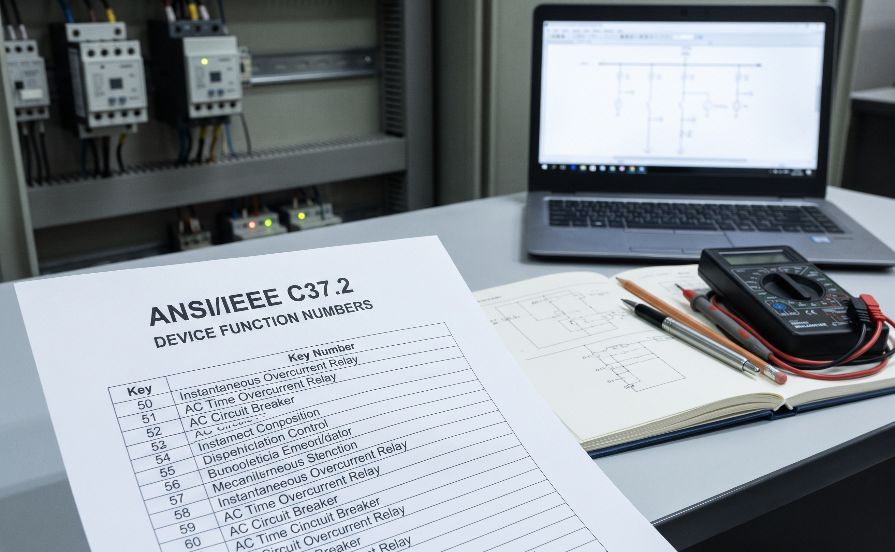
if a system has a protection relay or a single-line diagram engineered for fault studies, it probably uses ANSI numbers—regardless of whether it is 415V or 275kV.
Electrical drawings get crowded fast. Writing “Instantaneous and Time-Overcurrent Ground Fault Protection Relay” next to a symbol on an SLD is impractical, and language barriers can make international equipment manuals a headache.
The ANSI/IEEE C37.2 standard solves this by assigning a number from 1 to 99 to every common protection, control, and switchgear function. Once you learn the core numbers, you can read a protection scheme from almost any manufacturer—ABB, Siemens, SEL, Schneider, or GE—in seconds.
While the full standard covers nearly 100 functions, you will encounter a handful of “heavy hitters” on almost every site. Here are the essentials:
| Device Number | Function | What It Does |
| 27 | Undervoltage Relay | Trips or alarms when system voltage drops below a set threshold (e.g., to protect motors from stalling or to trigger an auto-changeover). |
| 50 / 51 | Overcurrent Relay | 50 is instantaneous overcurrent (trips immediately on a heavy short circuit). 51 is time-delayed overcurrent (waits longer for smaller overloads, trips faster for larger faults). |
| 52 | AC Circuit Breaker | The primary switching device capable of making, carrying, and breaking fault currents. |
| 59 | Overvoltage Relay | Protects equipment insulation from dangerously high voltage spikes or sustained overvoltage. |
| 87 | Differential Protection | Compares current entering a zone with current leaving it. If there is a mismatch, there is an internal fault—and it trips immediately. |
| 89 | Line Switch / Isolator | A disconnect or isolator switch used to physically isolate a circuit for maintenance (typically operated off-load). |
Understanding Suffixes and Prefixes
A single number tells you what the device does, but suffixes tell you where or how it does it. Combining numbers and letters is where the system becomes truly powerful.
- 87T: Transformer differential protection.
- 87G: Generator differential protection.
- 87B: Busbar differential protection.
- 87L: Line differential protection.
Auxiliary Contact Suffixes (e.g., 52a and 52b)
When you are tracing control schematics, you will constantly see 52a and 52b contacts. These aren’t the main power contacts of the circuit breaker—they are auxiliary contacts mechanically linked to the breaker mechanism used for interlocking, indication lamps, and SCADA status:
- 52a: Follows the breaker. It is closed when the circuit breaker is closed, and open when the breaker is open.
- 52b: Opposite to the breaker. It is closed when the circuit breaker is open, and open when the breaker is closed.
Quick memory trick: Think of 52a as “AND” (same state as the breaker) and 52b as “NOT” (opposite state to the breaker).
Neutral and Ground Suffixes (e.g., 50N / 51N)
Overcurrent relays often include N (Neutral) or G (Ground/Earth) to indicate earth-fault protection. For example, 50N/51N means instantaneous and time-delayed earth fault protection measured via the neutral/residual connection of the CTs.


